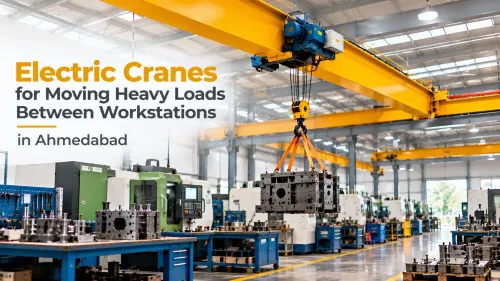



Heavy loads moving through receiving, storage, production support and dispatch create congestion when every transfer depends on forklifts or manual handling. By mapping each movement, checking the building and comparing equipment types, you can decide whether an overhead crane will improve warehouse flow in Ahmedabad and specify one that fits the work.
Key takeaways
- Use bridge, trolley and hoist travel to move loads in three directions.
- Check runway supports, roof clearance, slab capacity and power supply before installation.
- Choose an overhead crane when loads follow repeatable routes above clear floor space.
- Compare cranes with forklifts and gantries by access, flexibility, cost and floor traffic.
How an overhead crane moves a load through a warehouse
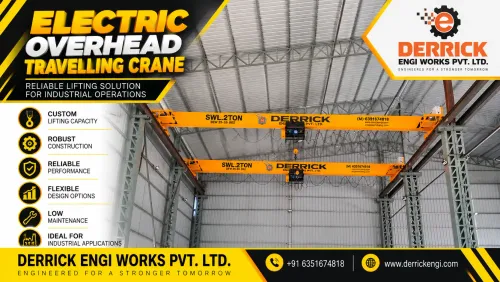
An overhead crane for warehouse operations moves a load in three directions without sending a vehicle through an aisle. The bridge travels along fixed runway rails; its trolley crosses the bridge, and the hoist raises or lowers the hook.
That fixed path connects receiving bays, storage positions, workstations and dispatch docks, but it does not provide a forklift’s free aisle-to-aisle travel.
- Receiving: Lift heavy incoming machinery, steel bundles, moulds or packed equipment from a vehicle into a staging area. This reduces repeated forklift transfers between the dock and inspection zone.
- Storage: Move loads from receiving to designated floor or rack positions, using the hook’s usable height and reach rather than occupying a permanent floor location with handling equipment.
- Picking: Retrieve a heavy unit or bundled material from storage and place it at an order-staging point. Use a lifting attachment suited to the load; a bare hook is not a substitute for secure load engagement.
- Production support: Transfer dies, tooling, raw material or completed assemblies between storage and a production cell. Repeating the same crane route makes scheduled material supply more consistent.
- Dispatch: Carry finished loads from staging to the dispatch bay for vehicle loading, keeping the main aisle clear during the transfer.
Select the crane’s rated capacity from the load, lifting attachment and below-the-hook device together. Markings must remain visible, and the fixed runway route must match your future layout because moving aisles later can require runway, electrical and operating-zone changes.
The warehouse movement benefits that matter in Ahmedabad
A crane can release floor area because the load travels above storage, staging and production zones instead of along a forklift aisle. Measure the improvement through forklift trips per shift, manual handling touches, blocked-aisle minutes, transfer time and usable floor positions before and after installation.
The warehouse lifting equipment benefits are strongest on repetitive, heavy routes:
- Fewer intermediate transfers between receiving, staging, production support and dispatch.
- Better use of vertical storage, provided hook height, rack geometry, sprinkler clearance and roof obstructions leave usable hook coverage.
- Less congestion where several loads follow the same fixed route.
- More consistent positioning for pallets, coils, machinery or fabricated components when the hoist and attachment match the load.
| Factor | Overhead travelling crane | Forklift |
|---|---|---|
| Travel pattern | Fixed runway and bridge path | Flexible aisle-to-aisle travel |
| Floor use | Leaves the route clear for people and storage | Needs driving lanes and turning space |
| Heavy repetitive moves | Efficient for repeated transfers at defined lift points | Adds travel, turning and truck interaction |
| Layout changes | Runway, power and operating zones may need alteration | Easier to redirect to a new aisle |
| Best advantage | High-volume lifting within surveyed coverage | Mixed locations, short moves and changing work areas |
These are the practical overhead crane benefits for warehouses in Ahmedabad: less floor obstruction and controlled heavy-load movement, not universal replacement of forklifts. A forklift still wins for outdoor yards, dock manoeuvring, irregular destinations and loads that fall outside the crane’s hook coverage. Suspended loads also demand exclusion zones, trained operators and collision controls.
Bridge, runway, hoist and controls: what you are specifying
The runway rails support fixed travel along the warehouse; end trucks carry the bridge between them. The bridge spans the working area, while the trolley crosses it. The hoist raises and lowers the load through the hook and its lifting attachment.
- Specify the runway length and bridge span from the required travel zone, not the building footprint.
- Rate capacity for the heaviest load plus slings, magnets, spreader beams or other below-the-hook equipment. Keep the rated-load marking visible.
- Set lift height from the highest storage or loading point, allowing for hook block length, load height, roof obstructions and sprinkler clearance.
- Check hook approach at both ends and along the sides; a long span does not help if the hook cannot reach rack positions.
- Match the hoist and bridge to the required duty cycle: lifts per hour, operating hours, load spectrum and expected fatigue life.
- Select separate lifting, trolley and bridge speeds for safe positioning and throughput. Fast travel is wasteful if operators need precise placement.
- Confirm the available power supply, voltage, phase, conductor bars and earthing before ordering.
- Choose a pendant for simple, visible routes or radio controls when the operator needs a clear view from changing positions. Include emergency stop, upper and lower limit switches, overload protection and travel limits.
A single-girder design fits lighter capacity, moderate spans and suitable duty cycles; choose double girder for greater capacity, longer span, higher lift or heavier service. Compare inspection access, records, spare parts and service response—not only hoist price.
Can the warehouse building support the crane?
A structural engineer must verify the building before a supplier designs runway beams. Floor area and roof height prove nothing: the assessment must calculate runway reactions, wheel loads, longitudinal and transverse forces, column capacity, anchor points and local connection details. Include the heaviest load, lifting attachment and below-the-hook device, not only the product weight.
Overhead travelling crane | Freestanding gantry Bridge support | Runway beams and rails fixed to the building | Legs on floor-level rails or wheels Structural check | Building columns, connections, rails and dynamic forces | Floor slab, rails, wheel loads and leg stability Clearance impact | Roof obstructions, sprinklers, racks and end approaches | Leg width and travel-side clearance reduce usable space Best fit | A suitable structure and fixed lifting route exist | The building cannot accept runway support
Confirm usable hook coverage before choosing the span. Check hook height, trolley and end approaches, roof services, sprinkler clearance, rack geometry and the highest required storage position; a long bridge still fails if the hook cannot reach the load.
Complete these checks before installation:
- Survey floor levels, column lines, rail alignment, door openings and power routes.
- Specify rated capacity, duty class, lifts per hour, operating hours, travel distance, ambient conditions and positioning accuracy.
- Provide safe access for inspecting hoist brakes, ropes or chains, hooks, wheels, rails, electrical equipment and limit switches.
- Set a documented inspection and lubrication schedule; neglected rails and wheels create noise, skewing and costly shutdowns.
These checks protect people and preserve warehouse lifting equipment benefits without forcing an unsuitable crane into the building.
Choosing between an overhead crane, gantry, forklift and other systems
Choose by usable hook coverage, load pattern and building support—not catalogue capacity. A single-girder overhead crane suits moderate loads, ordinary spans, compatible lift heights and light-to-medium duty where a lighter bridge keeps structural demand and cost under control.
Choose a double-girder crane for heavier loads, longer spans, higher lift, frequent cycling or greater top-running headroom; a cheaper single girder can leave inadequate hook height or fatigue margin.
| Option | What it means | When it applies |
|---|---|---|
| Single-girder overhead crane | Bridge runs on building-supported runways | Repetitive warehouse transfers where capacity, span, duty cycle and clearances fit a lighter design |
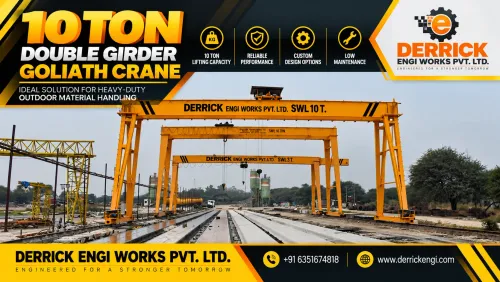
| Double-girder crane | Two main girders support the trolley and hoist | Higher capacity, longer spans, heavier duty or greater lift and headroom |
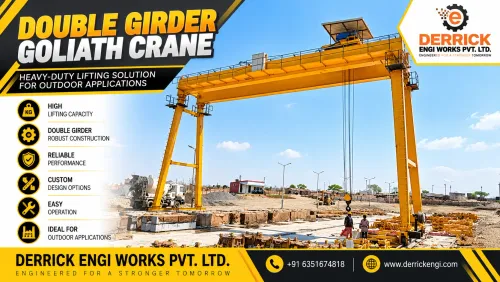
| Gantry crane | Bridge stands on legs moving on floor rails or wheels | No suitable runway structure; confirm floor strength, wheel loads and leg clearance |
| Monorail | Hoist travels along one fixed beam or track | A repeatable point-to-point route, not broad coverage across storage aisles |
| Jib crane | Rotating boom serves a local work zone | Machine loading, packing or workstation lifts within a limited radius |
| Forklift | Mobile vehicle carries loads at floor level and into aisles | Changing routes, pallet work and access where fixed paths would restrict operations |
Ask a warehouse crane supplier ahmedabad for a surveyed layout, hook-coverage drawing, load and duty calculation, runway or gantry reactions, commissioning test records, operator training and inspection documentation. An industrial crane manufacturer odhav, such as Derrick Engi Works Private Limited, should also define spare-part availability and service response times.
Frequently asked questions
How does an overhead crane move a load through a warehouse?
The bridge travels along fixed runway rails, the trolley crosses the bridge, and the hoist raises or lowers the hook. Together, these movements position a load across the warehouse without driving a vehicle through an aisle.
What warehouse movement benefits matter in Ahmedabad?
An overhead crane keeps lifting traffic above the floor, reduces aisle obstruction, uses repeatable travel paths and supports safer handling of heavy loads. Review heat, dust, monsoon moisture and available service access when specifying equipment for Ahmedabad.
What are the bridge, runway, hoist and controls?
The bridge is the moving beam, the runway is the rail system supporting bridge travel, the hoist lifts and lowers the load, and the controls operate travel, trolley and lifting motions. Specify capacity, span, lift height, speeds and control type together.
Can a warehouse building support an overhead crane?
A structural engineer must check runway beams, columns, connections, foundations, roof clearance, floor capacity and dynamic wheel loads. Do not assume an existing warehouse frame can carry crane loads without drawings and a site assessment.
When should you choose an overhead crane instead of a gantry crane or forklift?
Choose an overhead crane for repeatable lifting routes with clear floor space and suitable building support. Choose a gantry when permanent runway support is unavailable, a forklift when loads need flexible floor-level travel, and another system when the load path or operating conditions demand it.