
A steel plant can use a 10-ton double girder goliath crane only when the combined suspended load, operating cycle, heat and dust exposure, travel route, rails and controls match the plant’s work. By the end, you will be able to test the 10-ton rating against real loads and prepare the site and procurement information needed for a defensible decision.
Key takeaways
- Include the load, lifting gear and attachments when checking the 10-ton limit.
- Choose a goliath crane when outdoor access or ground-level rails suit the workflow.
- Specify duty class, lift height, span, travel speeds and environmental protection.
- Match controls and safety devices to the plant’s lifting cycle and operator needs.
Is 10 tons enough for the steel plant’s actual loads?
Ten tons is enough only when the plant’s heaviest complete lift stays within the crane’s rated capacity. That includes coils, billets, bundles, plates, moulds, dies, scrap bins and fabricated assemblies—not just the steel product.
For a 10-ton goliath crane for steel plant service, calculate the combined suspended load:
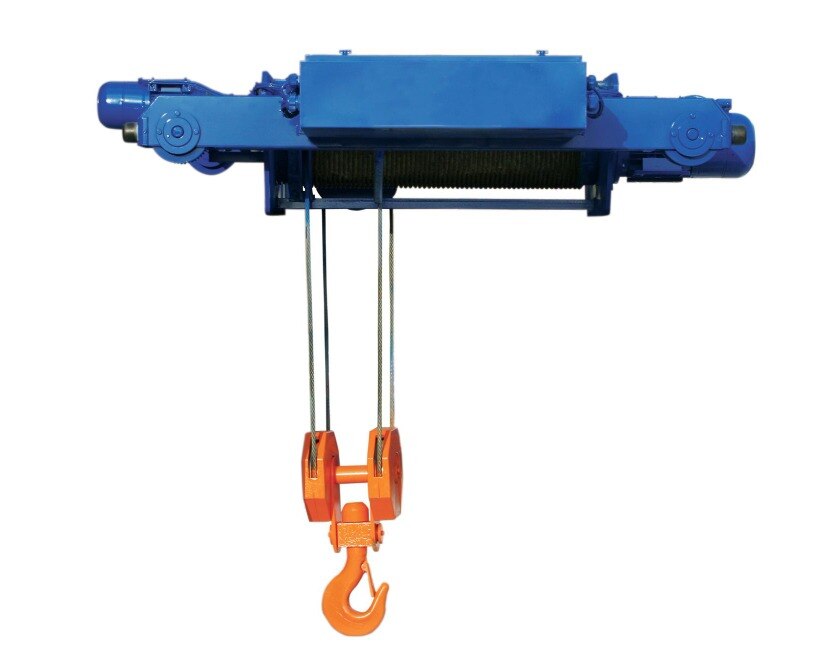
- Add the product, hook block, slings, lifting beam, C-hook, magnet, grab and every other below-the-hook device.
- Account for impact or dynamic effects, eccentric loading and the specified design margin.
- Confirm whether “10 tons” means the safe working load of the main hook, a combined capacity shared by multiple hooks, or only a nominal model description.
- Require the manufacturer to state that meaning on the load chart, with each hook and attachment capacity identified.
A 9-ton coil already exceeds the limit if its C-hook weighs 1 ton; acceleration, eccentric loading and design effects leave no usable allowance. For long billets or bundles, one hook can rotate the load and create dangerous swing even below 10 tons.
Specify a spreader beam, two-point lift, dual-hoist synchronisation or anti-sway control when the load geometry demands it.
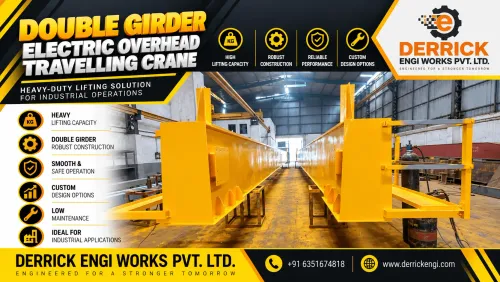
Double-girder construction can provide a top-running trolley, greater hook height or a wider span. It does not prove suitability for every steelmaking task, because the hoist, controls, attachments, duty and load path still require separate engineering.
When is a goliath crane better than an EOT crane?
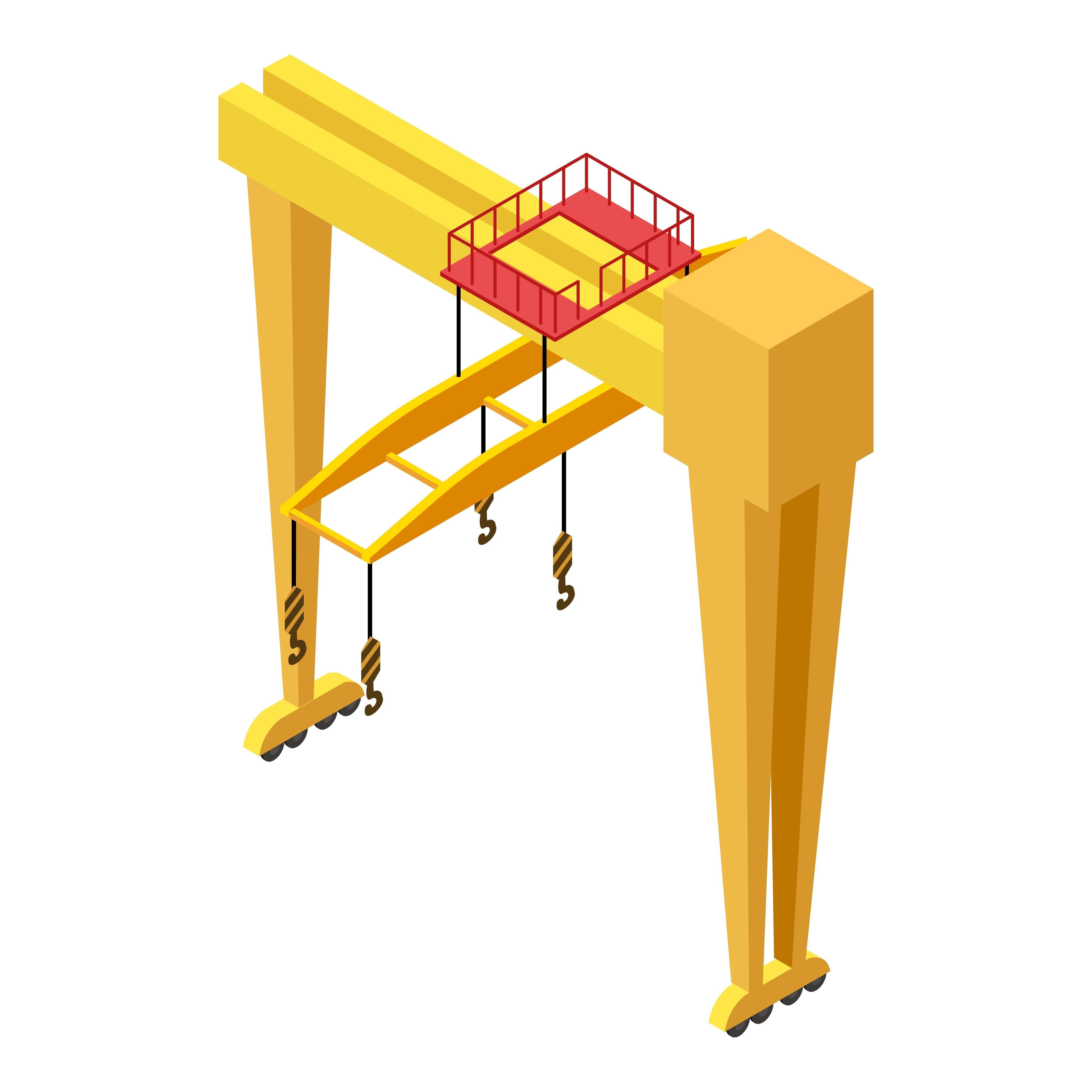
A goliath crane is better when the work happens outdoors, across an open fabrication area, or inside a bay without columns strong enough for an overhead runway. Its legs carry wheel loads into ground rails and foundations; an EOT crane transfers runway loads into the building structure.
The choice is also financial. A goliath avoids major building reinforcement but adds rails, foundations, drainage, rail anchorage and floor-level legs that compete with vehicles and storage. An indoor EOT crane can provide better weather protection and leaves the floor clear, provided the building already has a suitable runway.
A double girder goliath crane for manufacturing plant service suits wider spans or greater hook height, but “double girder” does not settle the decision.
Check the geometry before comparing quotations:
- Rail gauge, span and bay width
- Lifting height, under-clearance and hook approach at both ends
- Leg clearance, runway length and loading-point coverage
- Coil racks, mould pits, crossings, vehicle routes and parked equipment
- Maintenance access, buffers, end stops and travel-limit protection
Require the general arrangement drawing to show the hook under load, parked position, nearby equipment and every obstruction. A crane that reaches 10 tons but cannot place its hook over the loading point is unsuitable.
For a 10 ton gantry crane ahmedabad specification, state rail alignment tolerances, maximum wheel loads, rail anchorage, foundation tolerances, drainage and allowable settlement. Also require wheel equalization and anti-skew provisions; misalignment or settlement can cause flange wear, high drive loads and derailment risk.
What steel-plant conditions must the crane survive?
1. Before selection, record whether the crane serves an indoor bay or an outdoor yard. Document radiant heat, ambient temperature, distance from furnaces or ladles, hot scale, steam, water spray, conductive dust, rain, wind, corrosive fumes and abrasive mill scale. “Hot-environment” suitability is not a specification.
2. Furnace-side service requires defined operating temperature limits, including any reduced or prohibited operation above a stated temperature. Ask whether the design includes heat shields, protected cable routes, high-temperature lubricants, sealed electrical enclosures, and shielding for brakes and motors.
3. Outdoor service needs two separate wind cases: the maximum operating wind speed and the parked or survival wind speed. Specify the parking arrangement, such as rail clamps or another approved anti-runaway system; otherwise, a parked crane can travel along its rails during a storm.
4. For a 10 ton double girder goliath crane for steel plants ahmedabad, provide the project’s actual Ahmedabad site data. The structural and foundation design must identify the applicable Indian requirements for crane machinery, steelwork, wind, seismic effects, electrical systems and foundations, then apply the site temperature, wind record, corrosive exposure and rail layout.
Ask the supplier to state every limit on the load chart and operating instructions. A phrase such as “10 ton double girder goliath crane for steel plants ahmedabad” describes a search, not proof that the crane survives your furnace heat, dust, water or wind.
How should crane duty and controls match the work cycle?
Ten tons does not determine duty class. A double girder goliath crane for manufacturing plant service may lift 10 tons occasionally, or repeat near-rated lifts throughout every shift; those cycles impose different loads on motors, brakes, girders, wheels and foundations.
Record the work cycle before selecting the class:
- Lifts per hour, average operating minutes and lifting frequency
- Load distribution and percentage of time near rated load
- Hoist, trolley and crane travel distances
- Number of shifts per day and days per week
Use the project’s selected ISO 4301-1 classification, or an expressly specified FEM or CMAA system. Do not invent a class from the 10-ton rating. Two 10-ton cranes can therefore need different motors, brakes, structures, service lives and inspection intervals.
For a long outdoor gantry, compare the power arrangements against actual exposure and access:
| Option | Main exposure | Selection question |
|---|---|---|
| Festoon conductors | Scale, rain and vehicle impact | Can the cable route stay clear and accessible? |
| Cable reel | Reel wear, bending and travel limits | Does the reel suit the runway length and maintenance plan? |
| Conductor bars | Water, dust and accidental contact | Can barriers, enclosures and inspection access protect them? |
State incoming voltage and frequency, control voltage, pendant or radio control, variable-frequency drives, hoist and travel brakes, emergency-stop zones, overload protection, upper and lower limit switches, travel limits, buffers and end stops. Define cable-reeling limits.
Specify what happens after power loss: the brakes must hold the suspended load, and the restart sequence must prevent automatic motion when supply returns.
What should a buyer place in the engineering specification?
A quotation for a 10 ton double girder goliath crane for steel plants ahmedabad must describe the complete engineered system, not a nominal model.
State safe working load for each hook, the mass of every C-hook, magnet, grab, beam or other below-the-hook device, required hook height, minimum approaches, span, rail gauge, runway length, wheel arrangement and maximum wheel loads.
Site and operating inputs belong in the request:
- Specify anti-skew provisions, buffers, end stops, travel limits, rail tolerances, anchorage, allowable settlement, foundation reactions, drainage, wind cases, seismic inputs and parking restraints.
- State duty classification, load spectrum, lifts per hour, heat limits, dust, water and corrosive exposure, enclosure ratings, cable system, control method, emergency stops, brakes, drives, overload protection, inspection access and spare parts.
- Attach the actual bay drawing showing obstructions, coil racks, pits, vehicle routes, crossings and maintenance clearances, plus site temperature, wind, seismic, rail and foundation data.
| Document | Require from supplier | Why it matters |
|---|---|---|
| Load chart and GA drawing | Hook capacities, approaches, clearances | Exposes unreachable lifting points |
| Wheel-load drawing and reactions | Maximum wheel loads and foundations | Prevents rail or footing underdesign |
| Single-line diagram and control philosophy | Power, controls and restart behaviour | Defines safe operation |
| Test plan and limitations | Tests, exclusions and operating boundaries | Prevents assumed capability |
For a 10 ton gantry crane ahmedabad, Derrick Engi Works Private Limited may be considered, but compare its calculations, exclusions and site assumptions with the plant’s design review. Approve only when the load, route, environment and duty match.
Related product
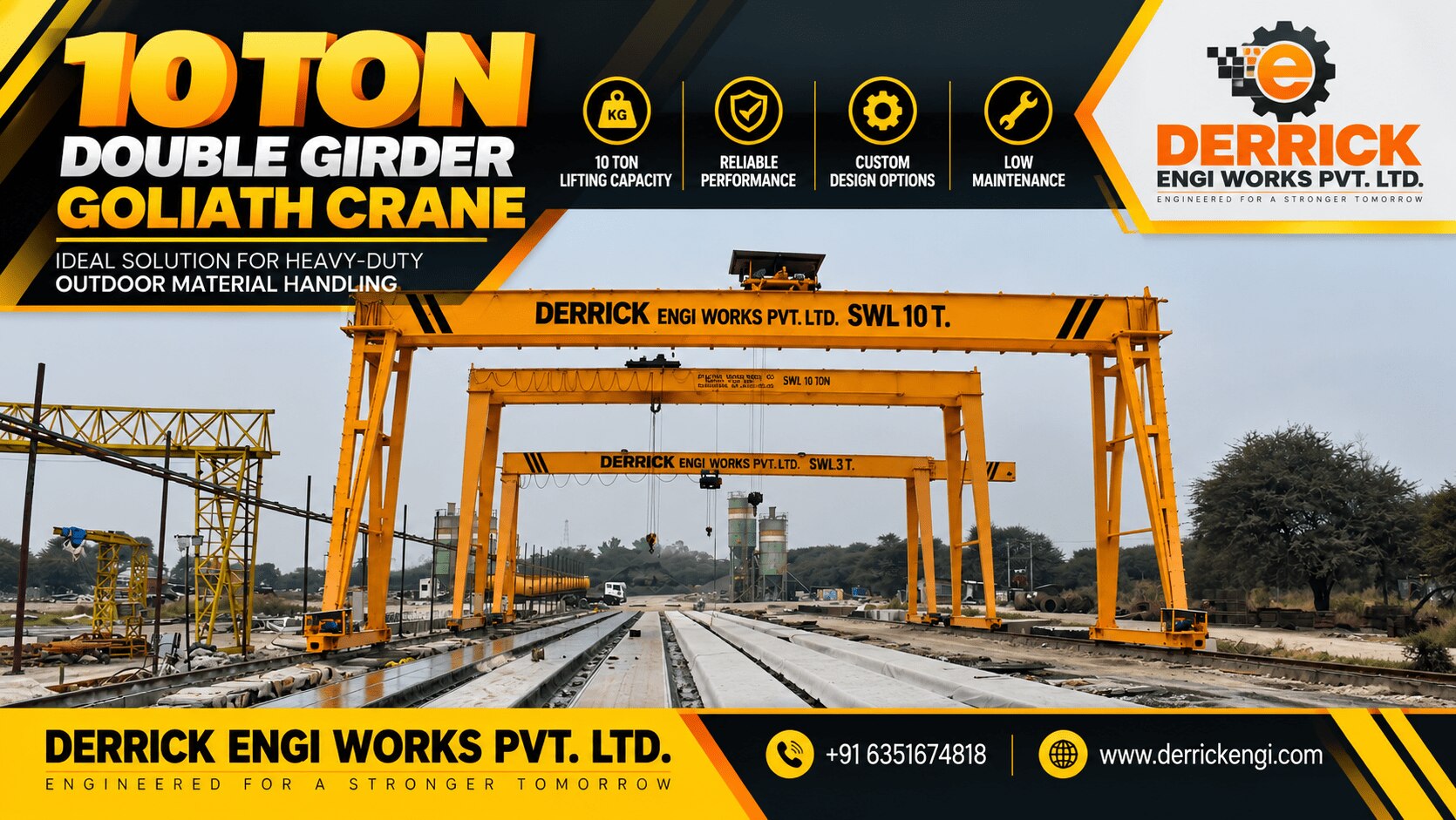 | Goliath Cranes/ Gantry Cranes 10-Ton Double Girder Goliath Crane 🏗️ 10 Ton Double Girder Goliath Crane Strength. Precision. Reliable Industrial Lifting. DERRICK ENGI WORKS PVT. LTD. View product → |
Frequently asked questions
Is 10 tons enough for a steel plant’s actual loads?
Ten tons is enough only when the heaviest complete lift remains within the rated capacity. Count the load, lifting beam, magnet, grab, hook block, slings and other attached equipment.
When is a goliath crane better than an EOT crane?
A goliath crane suits outdoor yards, stock areas and buildings without supporting runway beams. An EOT crane is usually better when the lifting path stays inside a building with existing elevated rails.
What steel-plant conditions must the crane survive?
Specify protection for dust, heat, rain, corrosion, impact risk and uneven outdoor conditions. Check the required enclosure ratings, materials, brakes, wheels and electrical components against the installation environment.
How should crane duty and controls match the work cycle?
Select the duty classification from lifting frequency, load spectrum, travel distance and operating hours. Choose pendant, radio or cabin control according to visibility, distance and operator safety.
What should a buyer place in the engineering specification?
State safe working load, span, lift height, rail gauge, speeds, duty class, power supply, site conditions, controls, safety devices, testing documents and maintenance access.