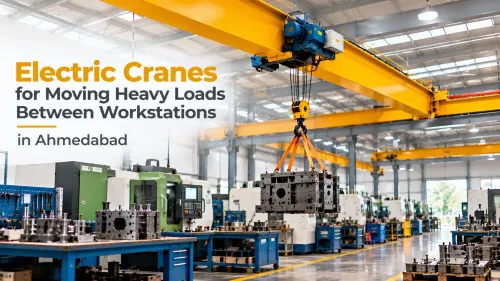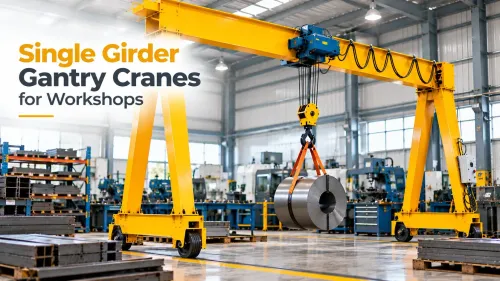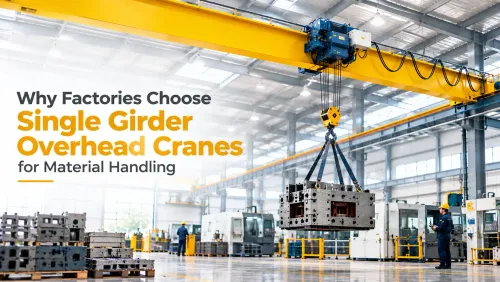


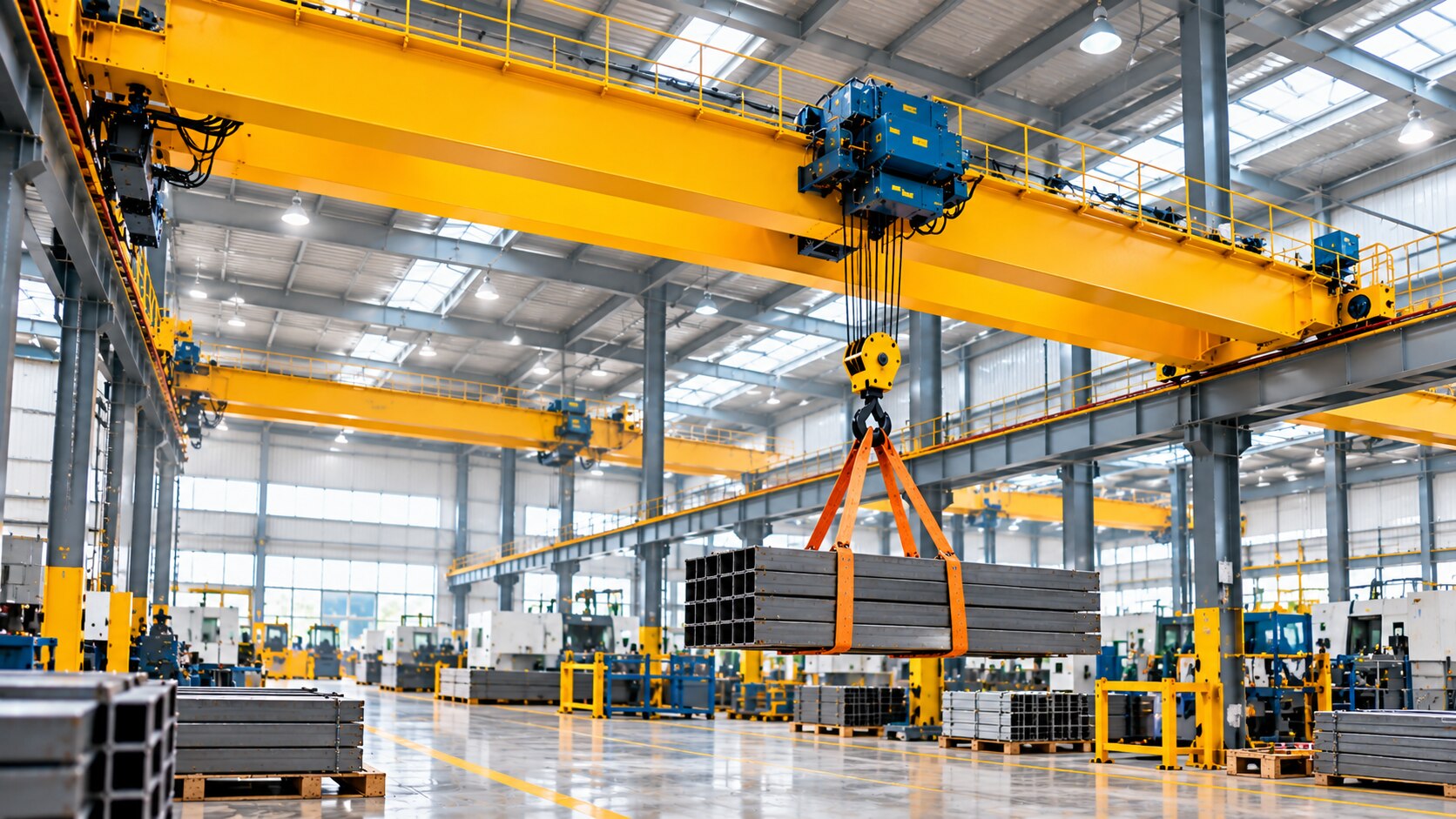
A crane becomes useful only when its lifting zone, travel path, hook reach and load limits match the way your factory or warehouse actually works. By the end, you will be able to map common Ahmedabad lifting tasks, compare crane types, check building suitability, define safe operation requirements and assess supplier quotations.
Key takeaways
- Use fixed cranes for repeated lifting between known workstations.
- Choose EOT, gantry or mobile equipment based on coverage and runway needs.
- Check load weight, span, lift height, duty cycle and building strength together.
- Compare quotations for engineering, installation, testing, training and after-sales support.
Where Ahmedabad factories use overhead cranes during daily work
Factories gain most from overhead cranes where loads repeatedly travel between known points: loading bays, production lines, maintenance stations and dispatch areas. A fixed runway keeps the hook above the work envelope, reducing forklift crossings and enabling accurate low-speed positioning of dies, moulds, motors, gearboxes, fabricated steel, pumps and process equipment.
These are practical industrial overhead crane applications:
| Task | Fixed-route movement | How to divide the area |
|---|---|---|
| Loading and unloading | Vehicle bay to receiving or staging | Separate truck lanes, pickup points and pedestrian routes |
| Production feeding | Stores to machine or assembly line | Mark the crane travel path and line-side set-down points |
| Die and mould handling | Storage rack to press or moulding machine | Create a clear lifting pocket around each machine |
| Maintenance | Workshop floor to motor, gearbox or pump location | Fence the set-down area and keep access to repair equipment |
| Fabrication and dispatch | Steel assembly between workstations and finished-goods bay | Mark fabrication cells, inspection points and dispatch lanes |
A search for “factory overhead lifting ahmedabad” often reflects this repeated movement inside textile, engineering, paper, chemical and general manufacturing plants. The crane works best when pickup and set-down points remain within its span and hook approach.
Divide the floor into four visible zones:
- Pickup zones where loads are attached and checked
- Travel paths beneath the runway, kept free of stored material
- Set-down zones with enough room for landing and securing the load
- Exclusion zones that stop people entering beneath a suspended load
An EOT runway suits an enclosed factory with suitable building support. Use floor-mounted gantry rails for an outdoor yard or a building without runway structure.
How to choose between an EOT crane, gantry crane and mobile equipment
Choose an EOT crane when heavy loads repeatedly travel along a fixed route inside a building. It suits a workshop material handling crane role between machine bays, fabrication stations, maintenance areas and storage positions, especially for coils, dies, moulds, long steel or machinery.
| Option | Best fit | Main limitation |
|---|---|---|
| EOT crane | Repetitive lifting across a defined indoor aisle; the runway uses building-supported beams | Needs verified building structure, runway space and electrical supply |
| Gantry crane | Outdoor yards, loading zones or buildings without suitable runway support | Requires floor rails, foundations, wind protection and weather-resistant equipment |
| Forklift or stacker | Mixed pallets, changing pickup points and short floor-level transfers | Less suitable for very heavy, long or suspended loads; needs traffic space |
| Hoist | Occasional lifting at one fixed point | Does not provide bridge travel across the work area |
| Jib crane | Local loading around one machine, bench or workstation | Limited reach and rotation; it cannot serve a long production route |
| Mobile crane | Temporary lifting, construction work or access across changing sites | Setup, ground bearing, outriggers and repositioning consume space and time |
For overhead cranes for industrial work areas in Ahmedabad, select the EOT arrangement when the same lifting path saves repeated forklift travel and floor traffic. A gantry is better when the work is outdoors or the building cannot carry runway beams; a mobile crane wins when the lift is temporary or locations change daily.
Compare the complete suspended load, not only the product: include hook block, lifting beam, magnet, grab, spreader and rigging. Keep a forklift when buildings, bays or storage positions change frequently. Surface-mounted hoists and jib cranes win for isolated points, not line-wide movement.
What the load, building and crane design must accommodate
Start with the heaviest complete suspended load, not the product alone. For overhead cranes for industrial work areas in Ahmedabad, the safe working load must include the hook block, lifting beam, grab, magnet, spreader and any other below-the-hook equipment.
Add the required duty cycle and operating class; an occasionally used maintenance crane is not equivalent to one feeding a production line all day.
Ask the supplier to calculate and state:
- Maximum lifted load, safe working load, span, runway length, lift height, hook approach and available headroom
- Bridge and hoist speeds, duty cycles, operating class, control method, power supply and testing requirements
- Indoor or outdoor location, ambient temperature, corrosive or hazardous conditions, electrical enclosure and rain protection
- Wheel loads, end-carriage forces and runway rail loads, with the design load combinations shown
- Required floor clearance, column spacing, roof-bracing clearance and safe hook coverage around racks, sprinklers, lights and doors
| Check | EOT crane on building runway | Gantry crane on floor rails |
|---|---|---|
| Main structure | Verify runway beams, brackets, columns, connections and foundations for wheel loads | Verify rails, foundations, rail alignment and wheel loads |
| Movement limits | Span, runway length, hook approach and obstructions define coverage | Rail length, leg clearance and ground-level obstacles define coverage |
| Outdoor exposure | Check wind and corrosion protection | Add wind loading, storm anchors or rail clamps, rain protection and corrosion control |
Do not approve a layout from capacity alone. A structural engineer must confirm the existing building can carry the crane’s moving loads, while the electrical design confirms voltage, conductor arrangement and available supply.
How to operate and inspect a crane safely in a busy work area
Stop the lift if people, vehicles or stored goods enter the load path. Factory overhead lifting in Ahmedabad needs a marked travel route, pickup and set-down points, and an exclusion zone that remains clear during every movement.
1. Before each shift, inspect the hook, latch, wire rope or chain, brakes, wheels, rails, pendant or radio control, emergency stop, limit switches and visible structural damage. Report fraying, bent hooks, oil leaks, unusual noise or faulty controls; isolate the crane until a competent person clears it.
2. Confirm the safe working load marked on the crane and include the hook block, lifting beam, magnet, grab, spreader and slings in the suspended weight. Check that the load is balanced, secured and within the approved lifting arrangement.
3. The trained operator must test the controls and brakes, lift a few centimetres, check stability, and travel at a controlled speed. Use a designated slinger or signaller when the operator cannot see the load, and use agreed hand signals or radio commands.
4. Never carry a load over people, drag a load sideways, stand beneath it, or use the upper limit switch as a normal stop. Keep racks, sprinkler pipes, lights, roof bracing and dock doors outside the hook path.
Record defects and arrange periodic examination and testing by a competent person under the applicable Indian factory rules and site procedure. Map warehouse overhead crane uses against the actual runway, bridge travel, hook approach and safe load-transfer zones; the crane cannot cover floor space beyond those limits.
How to compare crane quotations, installation work and supplier support
A low price is meaningless if suppliers have priced different lifting duties. Demand one quotation built from the same site data, with exclusions stated beside every included item.
- State safe working load, maximum lifted load including slings and attachments, span, runway length, lift, hook approach, headroom, bridge and hoist speeds.
- Require the operating class, duty cycles, indoor or outdoor location, ambient temperature, hazardous or corrosive conditions, control method and power supply.
- Require testing requirements, drawings, calculations, runway modifications, freight, installation, commissioning, operator training, warranty response time and spare-parts availability.
Installation support must cover runway-beam strength and alignment, column and wheel loads, deflection limits, rail joints, end clearances, power collectors, maintenance access and electrical connection. Ask the supplier to mark the hook path against racks, sprinkler pipes, lighting, roof bracing and dock doors.
Derrick Engi Works Private Limited can be asked to separate crane pricing from building strengthening, runway fabrication and commissioning so you can compare like with like.
| Option | What it means | When it applies |
|---|---|---|
| EOT crane | Fixed runway with bridge travel | Repeated transfers along a defined aisle |
| Gantry crane | Runway carried on legs and floor rails | Outdoor yards or buildings without suitable runway structure |
| Forklift or mobile equipment | Floor-level movement | Widely distributed pickups, inter-building travel or changing layouts |
A warehouse overhead crane does not cover every floor position. Choose a workshop material handling crane only when bays and set-down points remain stable; warehouse overhead crane uses become inefficient for mixed pallets, frequent layout changes or blocked travel paths.
Related products
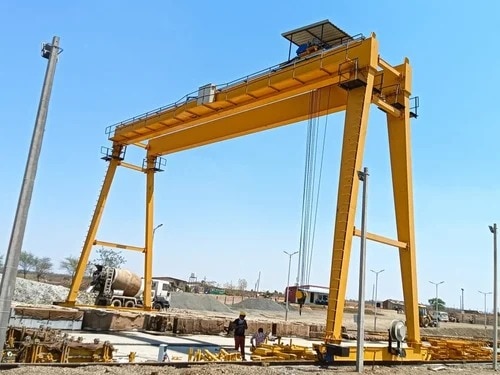 | Eot Cranes Single Girder Overhead Travelling Crane Manufacturer Derrick Engi Works Pvt. Ltd. is a trusted manufacturer and supplier of Single Girder Overhead Travelling Cranes, designed for efficient... |
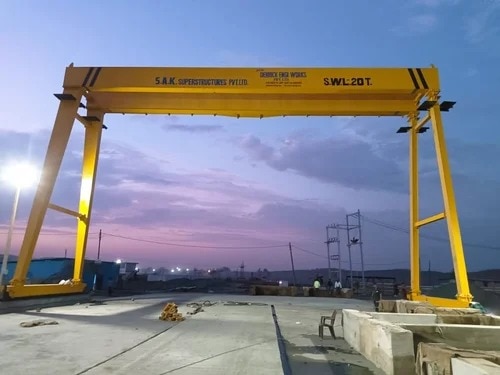 | Eot Cranes Electric Overhead Traveling Crane Manufacturer Derrick Engi Works Pvt. Ltd. is a trusted manufacturer and supplier of Electric Overhead Traveling Cranes, designed for efficient, safe,... |
Frequently asked questions
Where do Ahmedabad factories use overhead cranes?
Factories use them at loading bays, production lines, maintenance stations and dispatch areas to move dies, moulds, motors, gearboxes, pumps, fabricated steel and process equipment.
How do you choose between an EOT crane, gantry crane and mobile equipment?
Choose an EOT crane when loads follow a fixed indoor runway. Choose a gantry crane when support legs can run on floor rails or the building cannot carry a runway. Choose mobile equipment when lifting points change frequently or fixed infrastructure is impractical.
What must a crane design accommodate?
Confirm the safe working load, span, lift height, hook approach, travel path, duty cycle, load shape, power supply and the building's columns, runway beams, foundations and floor capacity.
What should you compare in crane quotations?
Compare the crane's duty rating, controls, brakes, limit switches, steelwork, installation, alignment, load testing, operator training, documentation, warranty response and spare-parts support.
Related product
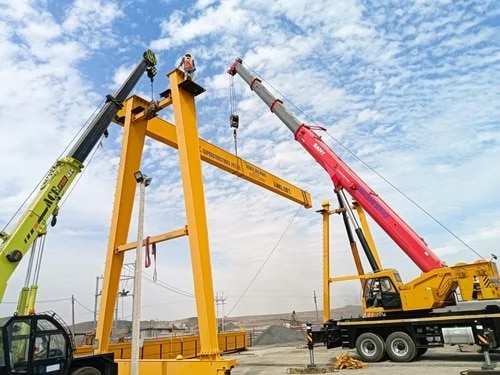 | Eot Cranes Gantry Crane Single Girder Crane Manufacturer Derrick Engi Works Pvt. Ltd. is a reliable manufacturer and supplier of Gantry Crane Single Girder Cranes, designed for efficient... |