

A factory must match its lifting equipment to load weight, travel paths, building structure and work intensity—not choose a crane from capacity alone. By the end, you will know when a single-girder layout delivers practical value, what to measure before requesting quotations, and when another lifting system is the safer fit.
Key takeaways
- Choose a single girder crane for broad coverage and lower structural loads.
- Check span, lift height, duty class, load weight, and lifting frequency before sizing.
- Confirm the building, runway beams, columns, and foundations can carry wheel loads.
- Choose a double girder, forklift, or jib crane when the application demands it.
Why a single girder can beat a double girder, forklift or jib crane
A single girder overhead crane for factories usually wins when repeated lifts must cover a broad rectangular work area without occupying the floor. One bridge girder generally uses less steel, creates lower dead load, and imposes lower wheel loads than a comparable double-girder crane.
| Option | Movement and coverage | Main limitation |
|---|---|---|
| Single-girder overhead crane | Hoist cross-travels on the bridge; end trucks long-travel along runway rails | Needs suitable building support and runway |
| Double-girder crane | Similar three-axis coverage with greater stiffness and trolley space | More steel, dead weight, wheel load, headroom demand and cost |
| Forklift | Flexible point-to-point floor traffic | Blocks aisles, needs turning space and repeated battery or fuel handling |
| Mobile crane | Lifts at changing outdoor or indoor positions | Requires setup area, ground preparation and repositioning |
| Jib crane | Serves a local circular radius around one column or foundation | Cannot reach bays, machines and storage points across a rectangle |
For recurring transfers between bays, machines, loading points and storage locations, the factory overhead crane keeps lifting above production traffic instead of sending forklifts through it. It also avoids the fixed lifting point and limited radius of a jib crane.
The bridge saving is not the whole project price. Runway steel, electrification, controls, access platforms and building reinforcement can exceed the difference between one and two girders. Choose another system when lifts are occasional, locations change constantly, or the building cannot safely carry runway reactions.
How the bridge, runway and controls move each load
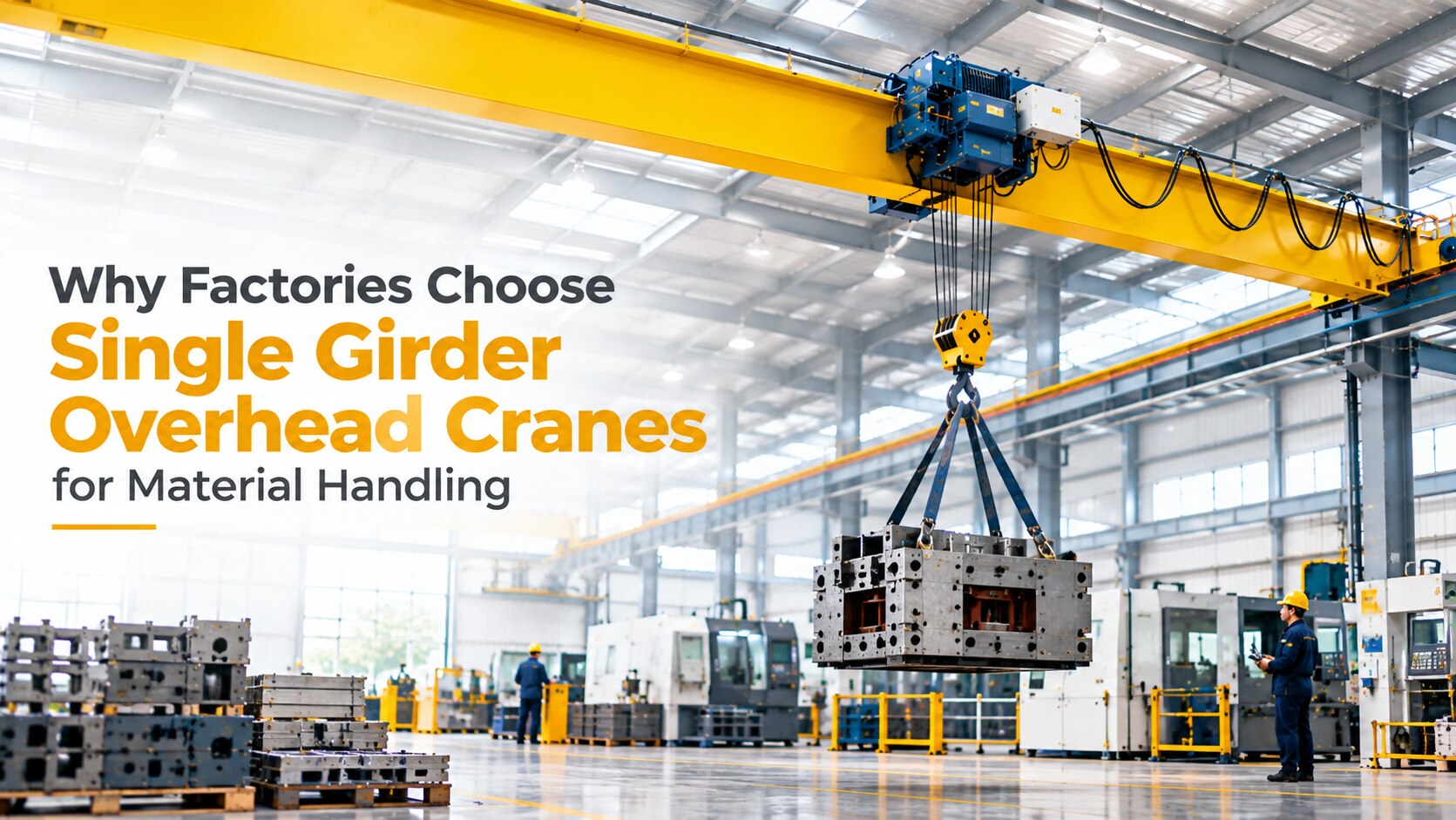
An operator controls the cycle through a bridge girder spanning the bay. End trucks carry the girder along runway rails, while the hoist and trolley move across the bridge. The hoist lowers and raises the hook, then the crane carries the load to its destination.
| Movement | What moves | Normal result |
|---|---|---|
| Lift | The hoist drum, rope and hook block | Raises or lowers the load |
| Cross-travel | The trolley and hoist along the girder | Positions the hook across the bay |
| Long-travel | The bridge and end trucks along the runway | Moves the load between locations |
The available hook approach and headroom determine whether the hook can reach a machine, truck or storage rack. A pendant gives the operator direct control from the floor; radio control allows a clearer or safer position when the load blocks access.
Hoist and travel brakes hold motion when controls are released, while runway stops limit bridge travel at each end. The operator needs an unobstructed sight line to the hook, load and landing area.
Repeated floor-to-floor or point-to-point handling reduces forklift congestion and avoids dependence on a fixed jib radius. Variable-frequency drives provide smoother acceleration and deceleration, reducing shock, but they do not create true anti-sway control. Suspended-load sway still depends on acceleration ramps, trolley speed, hook height, load geometry and operator technique.
A single girder crane for factory use needs those settings matched to the load, not selected from the drive specification alone.
Which operating figures determine the right crane size
The right crane size starts with the maximum lifted load, not the weight of the largest item alone. Add every below-the-hook component—lifting beams, grabs, magnets, slings, hooks and spreaders—to the load before specifying an industrial material handling crane.
State these operating figures in the enquiry:
- Maximum lifted load, span, runway length, lift height, hook approach, available headroom and bay dimensions.
- Lifting speed, cross-travel speed, long-travel speed, starts per hour, average load spectrum and required design life.
Safe working load is the crane’s permitted rated load; it is not a target to exceed. An overloaded crane increases brake, rope, girder and runway forces, while inadequate hook approach can leave the rated capacity useless at the loading point.
ISO 4301-1 classifies crane duty through load spectrum and working cycles. Therefore, two cranes with the same rated load can require different motors, brakes, gearing, bearings, wheels and structural sections.
| Crane comparison | Operating profile | Mechanical consequence |
|---|---|---|
| Same rated load, light and occasional lifts | Low average load spectrum and few working cycles | Lighter duty classification may suit the service |
| Same rated load, frequent lifts near capacity | High average load spectrum and many working cycles | Heavier mechanical design and greater fatigue life are required |
Check headroom around columns, machines and trucks as well as the nominal span. Girder depth, hoist-trolley geometry, runway elevation and end-truck dimensions determine whether the hook actually reaches the required points.
What the building and runway must support before installation
An existing factory is suitable only after an engineer verifies that its columns, roof structure, runway beams, foundations and anchors can carry the crane’s calculated reactions—not merely its rated lifting capacity.
Request a survey covering:
- Maximum wheel loads and vertical reactions at each runway support
- Horizontal surge and skew forces, anchor bolts and foundation condition
- Column capacity, beam connections, rail seats and load-transfer paths
- Clearances from roof members, columns, machines, trucks and walkways
The runway is part of the lifting system. Check rail alignment, elevation, straightness and support stiffness; poor geometry increases skewing, flange wear and drive loads. Require the supplier’s wheel loads and runway tolerances, with civil-work exclusions stated clearly.
| Arrangement | Headroom and support | Main limitation |
|---|---|---|
| Top-running | End trucks run on runway rails; girder depth and hoist height consume overhead space | Needs strong runway beams and supporting columns |
| Underslung | Wheels run beneath a supporting structure and can reduce top-side obstruction | Span, capacity, wheel loads and support geometry restrict use |
Measure actual hook approach and headroom, not catalogue dimensions. Include girder depth, hoist-trolley geometry and the space needed to clear columns, machines and trucks.
Specify the environment before selecting equipment. Heat, dust, chemical vapour, corrosion, washdown and outdoor weather affect enclosure ratings, motor insulation, brake protection, pendant protection, conductor bars or festoon systems, and the corrosion-protection system. These details can matter more than girder count.
When a single girder is the wrong choice—and how to buy responsibly
A single girder is the wrong choice when calculations show that capacity, span, duty cycle, hook height, stiffness or positioning accuracy exceeds its practical envelope. A double-girder crane can provide greater stiffness, trolley stability, maintenance space and auxiliary-hoist capacity, but it also adds mass, headroom demands and cost.
1. Match the layout before comparing prices. Choose a gantry crane when the building cannot safely carry runway reactions. Choose a jib crane for one workstation with a local lifting radius. Choose a forklift for flexible point-to-point work without a dedicated runway.
2. Give the supplier the operating figures: maximum load including slings, beams, grabs, magnets and spreaders; span; runway length; lift height; hook approach; headroom; speeds; starts per hour; load spectrum; and design life.
3. Request drawings showing clearances, girder depth, hook approach, runway tolerances and maximum wheel reactions. Ask for motor ratings, brake details, control voltage, electrical enclosure data and conductor or festoon arrangements.
4. Require load-test and commissioning records, inspection access, a maintenance schedule, spare-parts support and a defined warranty-response time. Searching “overhead crane manufacturer Ahmedabad” is useful only after this technical comparison; Derrick Engi Works Private Limited is one supplier to evaluate against it.
5. Confirm the current edition and project applicability of IS 3177 and IS 807 with the certifying authority. Do not treat a catalogue rating or location as proof that the crane suits your building.
Related products
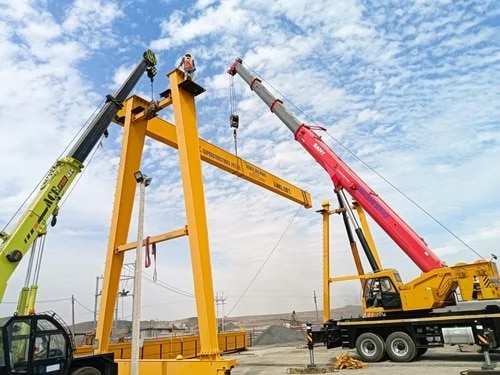 | Eot Cranes Gantry Crane Single Girder Crane Manufacturer Derrick Engi Works Pvt. Ltd. is a reliable manufacturer and supplier of Gantry Crane Single Girder Cranes, designed for efficient... |
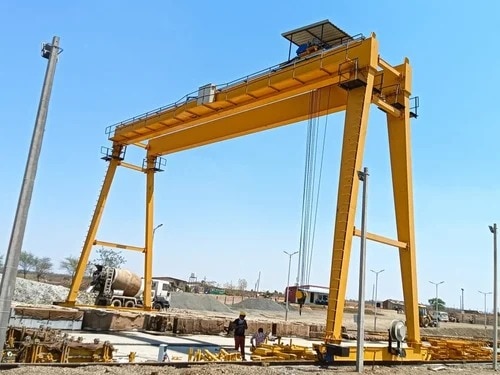 | Eot Cranes Single Girder Overhead Travelling Crane Manufacturer Derrick Engi Works Pvt. Ltd. is a trusted manufacturer and supplier of Single Girder Overhead Travelling Cranes, designed for efficient... |
Frequently asked questions
Why choose a single girder overhead crane instead of a double girder crane?
A single girder crane usually uses less steel, creates lower dead load, and imposes lower wheel loads while covering a broad rectangular work area. A double girder crane becomes more suitable for higher capacities, longer spans, greater lift heights, or heavier duty cycles.
How does a factory overhead crane move a load?
The hoist lifts and lowers the load on the bridge. End trucks move the bridge along runway rails, while the trolley moves the hoist across the bridge. Pendant, radio, or cabin controls direct these motions.
Which operating figures determine the right crane size?
Specify the rated load, span, lift height, runway length, hook approach, lifting speed, travel speeds, duty cycle, load frequency, and available power supply. Include the heaviest load and any impact from starting, stopping, or outdoor exposure.
What must a factory support before crane installation?
An engineer must check runway beams, rails, columns, brackets, foundations, clearances, power supply, and wheel loads. The building must support the crane's dead weight plus operating forces without excessive deflection or misalignment.
When is a single girder crane the wrong choice?
Choose another system when the load, span, lift height, duty cycle, or required hook coverage exceeds the single girder design. Forklifts suit changing travel routes, jib cranes suit local stations, and double girder cranes suit heavier or more demanding service.
Related product
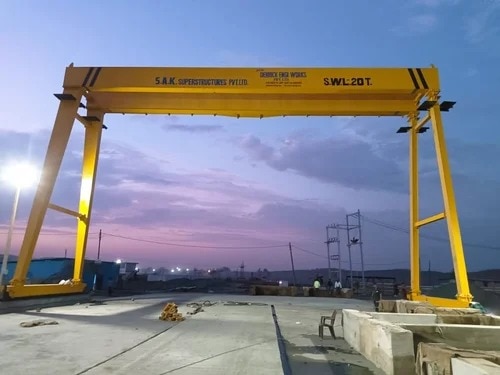 | Eot Cranes Electric Overhead Traveling Crane Manufacturer Derrick Engi Works Pvt. Ltd. is a trusted manufacturer and supplier of Electric Overhead Traveling Cranes, designed for efficient, safe,... |