


A 2,000 kg rating is enough only when your complete lifted assembly, building geometry, operating pattern and support structure all fit within the crane’s engineered limits. By checking the real load, hook position, runway and duty before ordering, you can decide whether two tons is adequate or whether the next capacity or a different crane arrangement is necessary.
Key takeaways
- Keep the complete suspended load below 2,000 kg, including slings and lifting fixtures.
- Reject the crane for side pulling, dragging, or lifting an unbalanced load.
- Measure span, headroom, runway travel, and every required landing point before ordering.
- Specify load, duty cycle, lift height, controls, power supply, and site dimensions in the enquiry.
Does the heaviest complete load stay below 2,000 kg?
A 2,000 kg crane is enough only when the complete suspended assembly remains below 2,000 kg. For 2 ton sg eot crane workshop use, calculate the load at the hook, not the component’s listed weight.
Include every item hanging below the hook:
- Motor, gearbox, die, pump, fabricated frame or machine part
- Slings, shackles and hooks
- Lifting beams and spreader bars
- Magnets, grabs, pallets and temporary fixtures
A 1,950 kg machine part does not fit a 2,000 kg crane when its lifting beam and rigging add 100 kg. Treat two tons as an upper limit, never as a target load.
Choose the next capacity when the weight is uncertain, the job changes between lifts, liquid or trapped material can add weight, or routine lifts approach the rated limit. The governing lift is often the largest awkward or off-centre assembly, not the workshop’s average motor or pump.
Check four figures separately: the crane’s rated capacity, safe working load, hoist capacity and usable capacity at the actual hook position. A two-ton hoist does not prove that the runway, trolley, columns, rails, building connections or foundations can carry the resulting wheel loads.
Do not drag, snatch, free stuck equipment or pull sideways with the hook; a vertical two-ton rating does not cover those forces.
Can the load be picked, balanced and moved without side pulling?
Map the lift before choosing a two ton crane for workshop lifting: mark the load’s centre of gravity, lifting points, travel route and final landing point. Locate every marked lifting lug and confirm its rated capacity and suitability for the planned sling arrangement. Include slings, shackles, lifting beams and other accessories in the crane-capacity calculation.
| Load condition | What happens | Correct response |
|---|---|---|
| Centre of gravity below the hook | The load remains stable if the rigging is equalised | Keep the hook vertically above the centre of gravity |
| Centre of gravity away from the hook | The load tilts and can rotate during travel | Use a spreader beam or adjust the rigging; never pull diagonally |
| Flat sling angle | Tension in each sling leg rises | Use the sling manufacturer’s angle limits and recalculate capacity |
Before lifting, inspect sling tags, shackle pins, hook latches and lifting-beam identification. Make a trial lift only high enough to confirm balance, then stop if the load rotates, shifts or strains one leg. Maintain a clear exclusion zone.
A pendant operator needs a clear line of sight. Radio control helps when equipment blocks the hook, but requires battery checks, pairing procedures and an emergency-stop arrangement. Keep the hook directly over the centre of gravity; a crane rated for two tons does not permit dragging, snatching or side pulling.
Reject this choice when the load cannot be weighed reliably, contains concealed material, has damaged lifting points or must be dragged into position.
Will the crane fit the workshop and reach the required landing points?
A two-ton crane fits only when its hook can reach every required landing point with enough vertical clearance. Measure the building before requesting a price.
1. Record the runway span, bay length, column spacing, crane rail elevation, floor-to-roof clearance, lowest roof obstruction, machine height, landing height and required hook travel.
2. Calculate lift height from the highest obstruction the load must clear before placement, not from the floor-to-roof distance alone. Allow for the hook block, minimum hook position, sling length, load height, roof structure and headroom above the crane.
3. Check end approach and trolley approach at both sides of the bay. A crane rated for two tons is ineffective if its hook cannot reach a machine, end wall, column line or maintenance position.
4. Mark the complete load path on a floor plan, including machine access, aisle widths, doors, maintenance zones and electrical panels. Show the hook’s usable envelope and landing heights on the general-arrangement drawing.
5. Have the runway engineered as part of the lifting system. Request checks for wheel loads, vertical impact, braking effects, transverse and longitudinal forces, fatigue, local deflection, rails, brackets, columns, building connections and foundations.
6. Never assume the floor slab can support runway reactions. Confirm the supporting structure before accepting a layout that lifts the load only in an unused part of the bay.
When is a single-girder crane the right workshop arrangement?
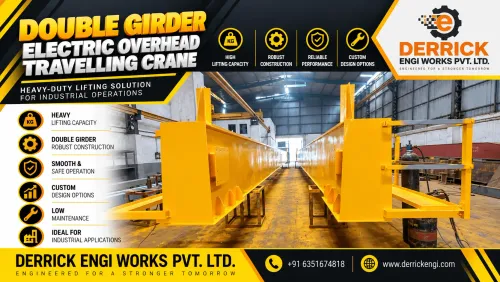
A single-girder crane is the right arrangement when a small workshop has moderate loads, defined coverage and limited production duty. “SG” does not establish span, lift, headroom, duty class, speed or structural suitability.
Compared with a double-girder EOT crane, a single-girder arrangement usually has a simpler, lighter structure and can provide a headroom or cost advantage. The actual result depends on the hoist, runway and building.
| Option | Arrangement | Best fit |
|---|---|---|
| Single-girder EOT | Lighter structure with two-axis coverage across a defined bay | Moderate loads and limited production duty |
| Double-girder EOT | Greater structural scope for capacity, span, duty and demanding cycles | Heavy, wide-span or frequent near-capacity work; allow for more headroom and supporting structure |
| Jib or mobile crane | Jib serves one workstation; mobile equipment avoids permanent runway construction but needs floor access, stability and manoeuvring space | Local lifting or sites where a permanent runway is impractical |
Do not choose by girder count alone. State lifts per hour, average load, near-capacity lifts, travel distances, starts and stops, operating hours and required service life.
A maintenance crane lifting a motor twice a week is not the same application as a production crane cycling near two tons all day. For sg eot crane workshop applications, compare EOT coverage with the narrower access problem a jib or mobile crane solves.
What should you put in the enquiry before approving a two-ton crane?
Write the enquiry as an installation specification, not “2 ton SG EOT crane.” Give the supplier measured site data and load requirements.
1. State the safe working load, span, runway length, lift, hook approach, minimum and maximum hook height, headroom, duty classification and operating cycle. Add control type, electrical supply, earthing, control voltage, ambient temperature, dust, humidity, rain exposure, corrosion risk and enclosure protection.
2. Request a general-arrangement drawing showing end clearances, trolley approach, hook envelope and landing heights. Require runway calculations, wheel-load data, building-support details and electrical drawings; a capacity plate cannot prove that the building and crane work together.
3. Make acceptance documentation part of the purchase: component certificates, inspection and maintenance instructions, proof-load results, functional-test records and the stated inspection regime. Specify upper overtravel protection, emergency stop, overload protection or load-limiting logic, travel limits where needed, audible or visual warning, guarding and a visible rated-load plate.
4. For a two ton sg eot crane for workshop ahmedabad or a small workshop eot crane ahmedabad, describe the actual bay rather than relying on catalogue capacity.
Compare proposals from Derrick Engi Works Private Limited and every alternative against the same drawings, calculations, tests and documents, then confirm the installed crane, runway and building before acceptance.
Related product
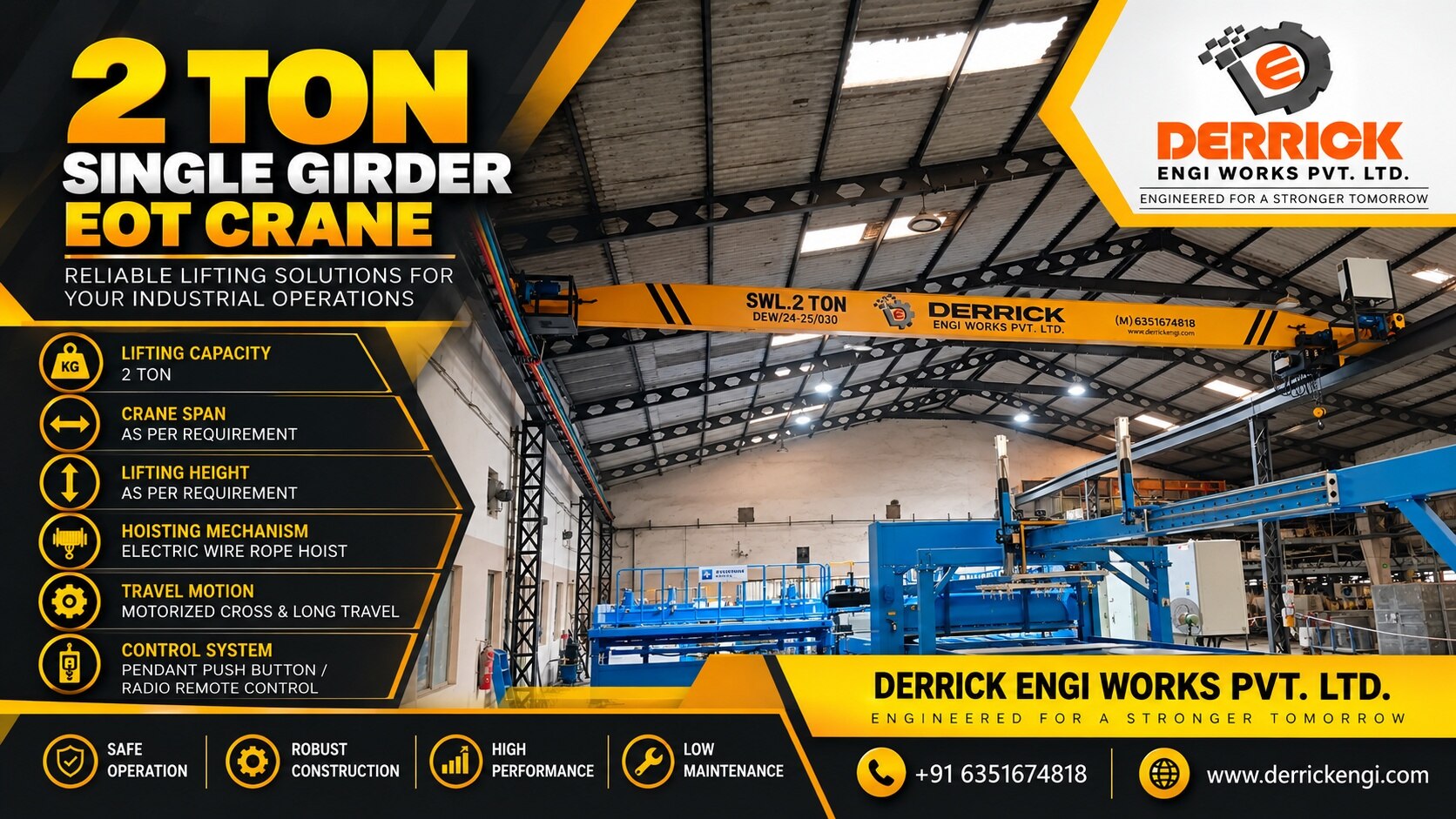 | EOT Cranes 🏗️ 2 Ton SG EOT Crane | Single Girder EOT Crane Looking for a practical overhead material-handling solution for your industry? DERRICK ENGI WORKS... View product → |
Frequently asked questions
Is a two-ton SG EOT crane enough for a workshop?
It is enough when the complete suspended load at the hook stays below 2,000 kg and the crane can reach every required landing point.
What weight should you calculate for two-ton crane lifting?
Calculate the complete suspended assembly: the load, pallets or containers, slings, shackles, spreader beams, lifting fixtures, and other equipment hanging from the hook.
Can a two-ton SG EOT crane move loads with side pulling?
No. Pick the load vertically and keep it balanced before travel. Side pulling can damage the hoist, rope, hook, trolley, runway, and supporting structure.
When is a single-girder EOT crane suitable for a workshop?
A single-girder arrangement suits workshops needing moderate lifting capacity, practical hook coverage, and lower structural demand than a double-girder crane.
What information belongs in a two-ton crane enquiry?
Provide the maximum complete load, lift height, span, runway length, landing points, duty cycle, lifting speed, controls, power supply, headroom, indoor conditions, and site location.