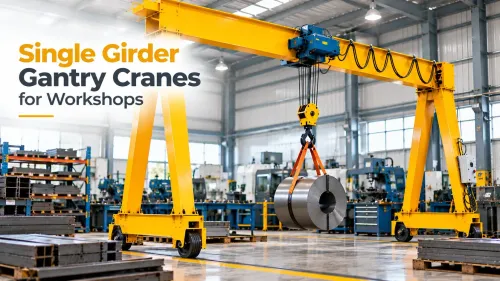


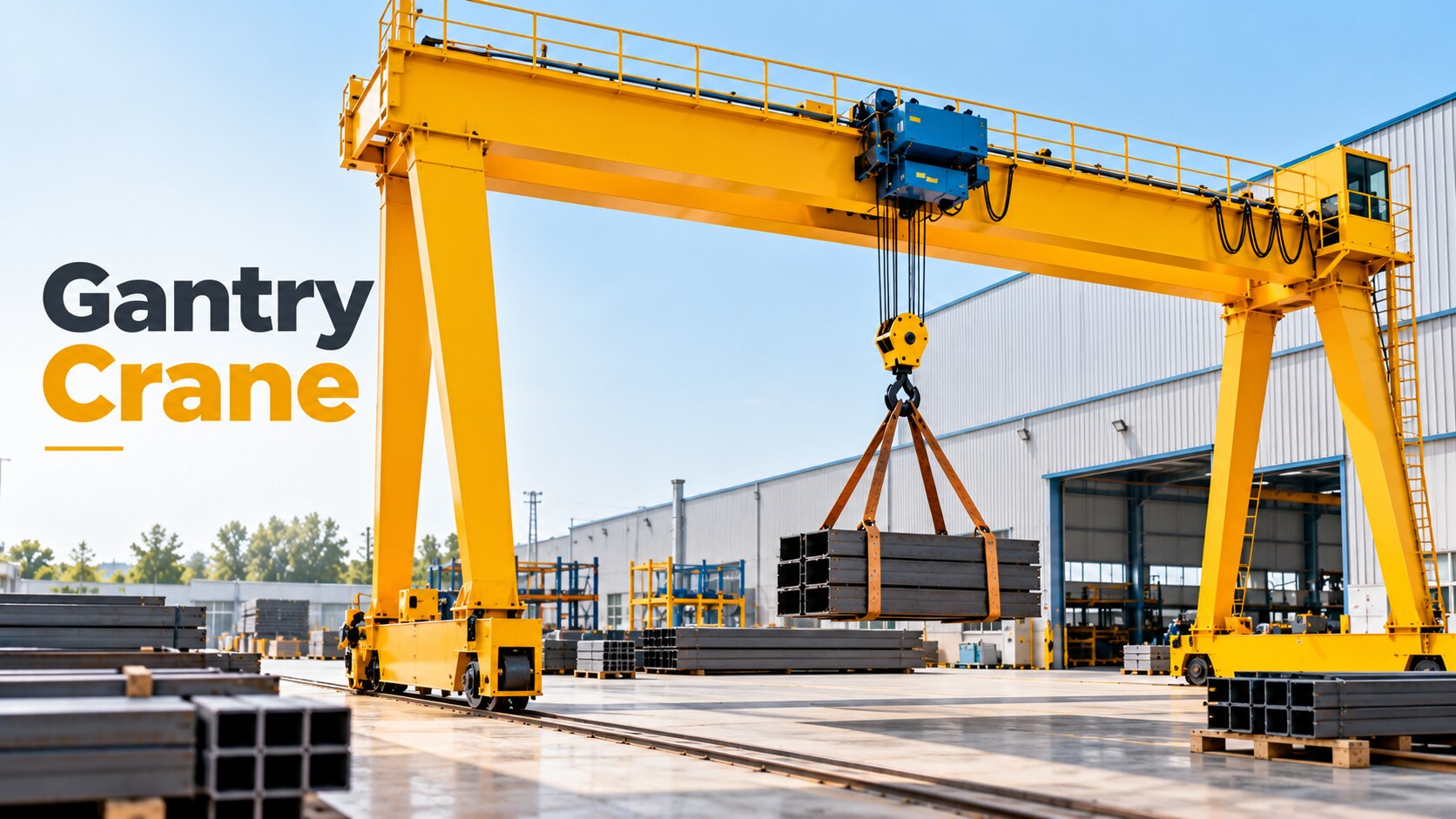
Choosing a factory gantry crane starts with the building, floor, travel route, and lifting pattern—not the rated tonnage alone. By comparing crane layouts, specifying the right operating data, checking site constraints, and testing the delivered equipment, you can request quotations that are technically comparable and suitable for your Odhav unit.
Key takeaways
- Choose floor-supported or rail-mounted gantry travel by load route and relocation needs.
- Include span, lift, capacity, duty class, power supply, controls, and site dimensions in the quotation.
- Verify floor capacity, rail alignment, headroom, lifting-zone clearances, and end stops before installation.
- Compare drawings, load tests, manuals, warranties, and commissioning records—not only the quoted price.
Which gantry arrangement fits your factory layout?
A floor-supported gantry suits a factory that lacks crane runway beams, but the arrangement determines where the load can travel and what the floor must carry. Choose by route, relocation needs, and building structure—not by the search phrase “single girder gantry crane Ahmedabad.”
| Option | What it means | Best factory use |
|---|---|---|
| Rail-mounted | Legs run on fixed floor rails; accurate, repeatable travel | A dedicated bay with regular lifting routes and prepared foundations |
| Rubber-tyred | Tyred legs travel on concrete without rails | Outdoor yards or changing work areas; requires a controlled route and firm, level floor |
| Portable | A small free-standing frame moves by casters or manual handling | Light loads and occasional maintenance, not continuous production duty |
| Fixed | Legs are anchored at one location | A permanent loading or machine-service point |
| Semi-fixed | The frame is bolted to prepared plates or rails and can be relocated with planned work | Factories that may change their bay layout |
| Overhead travelling (EOT) | The bridge runs on elevated runway beams attached to building columns or structure | Indoor production bays where floor space must remain clear |
A rail-mounted gantry needs rail gauge, alignment, drainage, and foundations designed for wheel loads, braking, skewing, and buffer impact. The crane’s gross mass alone cannot validate an existing floor.
An indoor EOT preserves floor aisles, but ordinary roof strength does not prove the columns and connections can carry crane reactions. Use a gantry when the building cannot accept runway loads; use an EOT when clear floor space and suitable structural support matter more than independent foundations.
What must your crane quotation specify before pricing?
A quotation is incomplete if it says only “5-ton single-girder gantry crane.” Ask the supplier to price a defined lifting envelope, duty class, operating speed, hoist arrangement, and control system.
| Item | Quotation must state | Why it matters |
|---|---|---|
| Rated capacity | Safe working load in tonnes, including below-hook equipment | A 5-ton rating does not cover a 5-ton load plus a spreader beam |
| Span | Rail centre-to-centre dimension and maximum span | Span affects girder size, deflection, and wheel loads |
| Lifting height | Maximum hook height, minimum hook height, and usable lift | A nominal height can leave pallets unreachable below obstructions |
| Approaches | End approach, side approach, hook clearance, and column interference | The hook can meet the span yet miss machines or wall-side loading bays |
| Duty | ISO 4301-1 or FEM class, lifting cycles, and percentage of rated-load lifts | Duty determines hoist, brake, motor, wheel, and girder sizing |
| Speeds | Hoist, trolley cross-travel, and gantry long-travel speeds | Speed changes handling time, stopping distance, and impact risk |
| Hoist and controls | Hoist type, reeving, brake, pendant or radio control, control voltage, and emergency stop | Identical capacity cranes can have different usability and safety |
Require the offer to include maximum wheel load, wheel spacing, rail reactions, braking and skewing forces, buffer impact, crane self-weight, power supply, earthing, isolation point, and moving-power method. A trailing cable, festoon, and conductor bars create different snagging and maintenance demands.
Ask for the component manufacturers, design standard, warranty exclusions, commissioning scope, and acceptance-test criteria before comparing prices.
Can the floor, rails, and lifting zone accommodate the crane?
A gantry crane fits only when the floor, rails, lifting envelope, and traffic routes work together. For a gantry crane for factories in Odhav Ahmedabad, do not approve the design from rated capacity or gross crane mass alone; obtain maximum wheel loads, wheel spacing, rail reactions, braking forces, skewing forces, and buffer-impact loads.
1. Survey the proposed travel path. Record rail gauge, floor level, flatness, foundation depth, reinforcement locations, drainage, and any floor joints. Check that rail foundations can resist concentrated wheel loads without settlement or rail misalignment.
2. Mark the lifting envelope on a floor plan. Show maximum span, bay length, hook height, end approach, side approach, columns, walls, loading bays, machines, and storage racks. A crane can meet its quoted span yet leave pallets beside a wall outside the hook’s reach.
3. Measure the clear height from floor to roof members, lights, sprinklers, ducts, and electrical lines. Include the hoist body, lifted load, sling angle, and required headroom—not only the hook’s maximum height.
4. Preserve separate pedestrian aisles and vehicle lanes beneath and beside the rails. Check the crane’s overall leg width, trolley projection, load width, and turning radius for forklifts, trucks, and the largest load.
5. Confirm the full travel distance, stopping points, buffers, wheel stops, and maintenance access. A short bay can force repeated repositioning; inadequate turning space can make a correctly sized crane unusable.
The survey should also record the load’s dimensions and centre of gravity, available power connection, dust, fumes, chemicals, heat, and wash-down exposure. Use these findings to compare rail-mounted legs with a rubber-tyred or portable arrangement before selecting the crane.
How should the crane handle Ahmedabad’s outdoor and congested conditions?
Specify an outdoor gantry crane for its worst site condition, not for an indoor catalogue image. Dust, monsoon water, foundry fumes, chemical corrosion, high heat and wash-down affect motors, brakes, lubrication, panel ventilation, cable systems and enclosure selection.
| Condition | Specify | Why it matters |
|---|---|---|
| Dust or wash-down | Sealed electrical enclosures, protected festoon or conductor bars, suitable motor insulation and drainage | Dust enters controls; standing water causes faults |
| Corrosive fumes | Corrosion-resistant coatings, hardware and lubrication schedule | Rust weakens steelwork and shortens component life |
| Wind exposure | Wind design, rail clamps, storm anchors, buffers or wheel chocks, and a marked parking position | An enclosure rating does not stop an idle crane moving in a storm |
| Walls and shared routes | Long-travel limits, buffers, anti-collision devices and physical exclusion zones | A limit switch alone cannot prevent impact or protect pedestrians |
| Restricted sight lines | Radio remote control, audible warning, beacon, emergency stop and a defined signalling method | The operator must control the load without walking into its path |
State the supply voltage and frequency, permissible voltage variation, control voltage, earthing method, lockable main isolator, short-circuit rating and emergency-stop circuit. Choose trailing cable, festoon or conductor bars after checking snagging, vehicle crossings and maintenance access.
Specify upper over-hoist, cross-travel and long-travel limits, overload protection, phase-loss and phase-sequence protection separately from normal controls. A site survey must record drainage, wind exposure, obstructions and the stowage point before finalising the design.
How should you compare an Odhav supplier’s offer and acceptance documents?
The phrase “gantry crane manufacturer odhav” identifies a search result, not equivalent equipment. Compare the complete technical bill of materials, including hoist, motors, brakes, controls, structural steel, wheel assemblies, and component manufacturers; a local fabrication address or lower price does not prove matching performance.
| Document | Verify before approval |
|---|---|
| Quotation | Capacity, span, lift, hook approaches, speeds, duty class, environment, design standard, delivery, warranty exclusions, commissioning scope, and service response |
| Purchase order | IS 3177, IS 807, and IS 3938 with editions named; assign each standard to structure, mechanical, electrical, testing, and documents |
| Commissioning record | Rail alignment, wheel tracking, lubrication, electrical insulation, phase sequence, limit switches, brakes, emergency stop, and unloaded operation |
| Final acceptance | Rated-load operation, brake holding, hoist and travel limits, emergency stop, measured deflection where specified, actual hook height, approaches, and buffer performance |
Require the supplier to state maximum wheel load, wheel spacing, rail reactions, braking forces, skewing forces, and buffer impact. Crane mass and rated capacity alone cannot validate an existing floor or foundation.
Before final payment, collect load-test certificates, motor and brake data, electrical drawings, inspection instructions, spare-parts lists, and examination intervals. Derrick Engi Works Private Limited is worth comparing on whether its offer states these deliverables rather than merely naming a crane type.
If outdoor dust, fumes, chemicals, heat, or wash-down applies, make the quote identify enclosure protection, motor insulation, brake type, panel ventilation, conductor protection, and lubrication intervals.
Related product
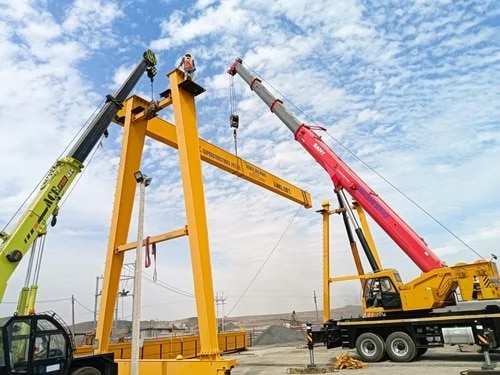 | Eot Cranes Gantry Crane Single Girder Crane Manufacturer Derrick Engi Works Pvt. Ltd. is a reliable manufacturer and supplier of Gantry Crane Single Girder Cranes, designed for efficient... |
Frequently asked questions
Which gantry arrangement fits a factory layout in Odhav Ahmedabad?
Choose a floor-supported gantry when you lack runway beams. Compare fixed, adjustable, rail-mounted, and rubber-tyred arrangements by travel route, floor condition, relocation needs, and required clearance.
What must a gantry crane quotation specify before pricing?
Request the safe working load, span, lift, travel and hoist speeds, duty class, control method, power supply, operating area, steel grade, safety devices, installation scope, and delivery exclusions.
Can the factory floor, rails, and lifting zone accommodate the crane?
Check floor bearing capacity, rail foundations and alignment, wheel loads, runway length, headroom, side clearances, end stops, access routes, and the exclusion zone below suspended loads.
How should you compare a gantry crane supplier's offer and acceptance documents?
Compare the general arrangement drawing, load and wheel-load calculations, electrical schematic, inspection certificates, overload-test report, operating manual, maintenance schedule, warranty, and commissioning records.