

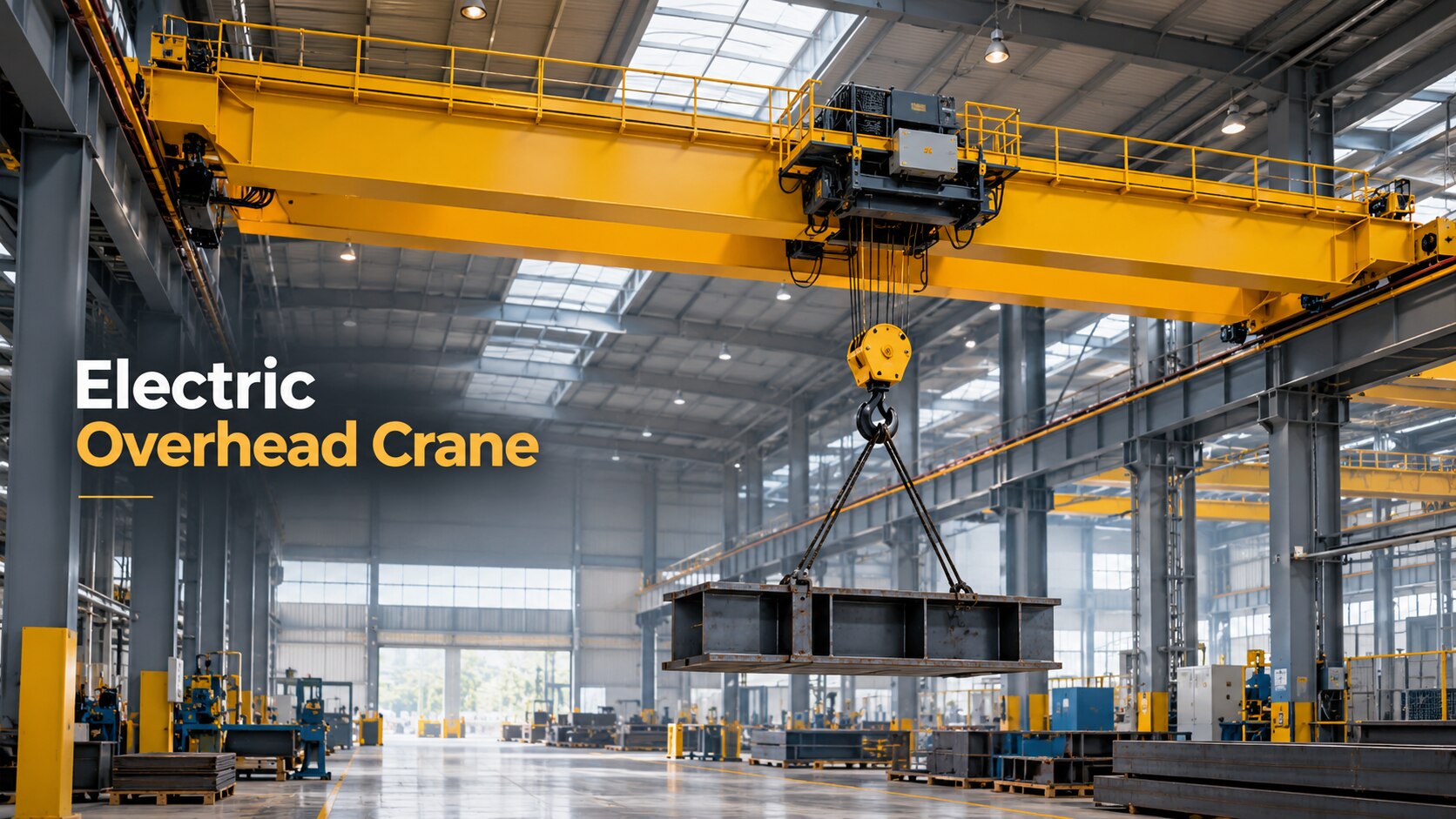
A crane rated for the heaviest product can still fail your factory if its duty cycle, hook height, runway loads, electrical supply, or clearances are wrong. By the end, you will have a practical specification for comparing crane configurations, alternatives, quotations, and future expansion needs.
Key takeaways
- Calculate gross suspended load, including every below-hook attachment.
- Measure runway span, bay length, headroom, and the full hook envelope.
- Choose single- or double-girder construction from span, lift, and duty demands.
- Compare RFQs for safety systems, maintenance access, controls, and total fit.
Start with the Gross Load and Duty Cycle
The best EOT crane for factory operations is sized for the maximum gross suspended load, not the product alone. Add the hook, slings, spreader beam, magnet, grab, lifting frame, and every other below-hook device used during the heaviest lift. Document whether each attachment is permanent or interchangeable.
Add a documented allowance for identified future production loads. Do not substitute an arbitrary overload margin for engineering calculations; an oversized capacity rating cannot correct an underspecified hoist, brake, gearing, wheels, or electrical system.
Record these operating figures before requesting quotations:
- Rated load and maximum gross suspended load
- Lifts per hour and starts per hour
- Average load as a percentage of rated load
- Average travel distance per lift
- Operating hours per day, shifts per day, and working days per year
- Expected future loads and the calculation supporting the allowance
Use the data to define the service requirement under ISO 4301-1, the applicable FEM group, or CMAA Class A through F. A maintenance crane used a few times weekly does not need the same classification as a production-line crane running continuously. This duty-cycle record is the core of any reliable electric crane selection guide.
Measure the Bay, Runway, and Hook Envelope Before Quoting
A crane that lifts the specified load but cannot reach a pickup point is not fit for purpose. Give suppliers a dimensioned site drawing, not estimates.
1. Measure bay length, runway length, bridge span, runway rail gauge, required maximum and minimum hook elevation, and available lifting height. Record hook approach distances at both ends and both sides.
2. Mark headroom above the runway, trolley envelope, aisle width, end clearances, and maintenance access. Locate roof obstructions, lights, sprinklers, ducts, doors, utilities, columns, and equipment that could restrict travel or servicing.
3. Show possible runway extensions, transfer points, additional cranes, and future load areas. Fixing today’s geometry without these allowances can make later capacity increases impossible.
4. Ask a structural engineer to verify column and foundation capacity, rail alignment, runway deflection, maximum and minimum wheel loads, lateral surge, longitudinal forces, seismic requirements, and future crane loads.
5. Require the supplier to state its runway reactions and design assumptions. The building owner remains responsible for confirming that the supporting structure accepts those reactions.
These measurements let you compare factory overhead crane options on usable coverage, not headline capacity alone.
Choose Single-Girder or Double-Girder from the Working Envelope
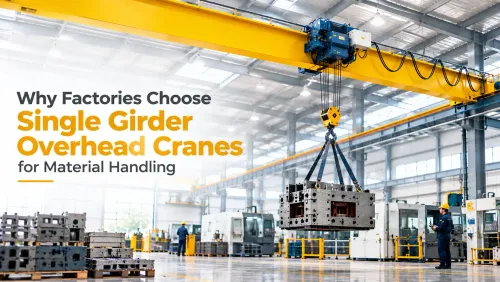
The best EOT crane for factory operations is the one that fits the working envelope, not the one with the lowest price. A single-girder design suits moderate loads when lower dead weight, reduced runway reactions, compact equipment, and economical installation matter.
| Dimension | Single-girder | Double-girder |
|---|---|---|
| Required load | Moderate capacity within manufacturer limits | Higher capacity and heavier below-hook equipment |
| Span | Shorter or moderate spans | Longer spans with greater bridge stiffness |
| Lifting height | Adequate where headroom is available | Greater lift where hook elevation is critical |
| Duty cycle | Maintenance and moderate production use | Heavy, frequent, continuous production service |
| Hoist speed | Standard handling rates | Faster handling and higher production throughput |
| Hook approach | Acceptable end and side reach | Closer approaches to walls and bay ends |
| Headroom | Compact hoist suits tight overhead space | Configuration may provide greater lift height |
| Below-girder access | More obstruction from the hoist arrangement | More clear space beneath the bridge |
Its practical capacity, span, hook height, and duty envelope become restrictive as loads, lifts, spans, or production intensity rise. Double girder deserves consideration when you need higher capacity, longer span, greater lifting height, heavier duty, faster handling, closer hook approaches, or more access beneath the bridge.
To choose an electric overhead crane for a factory, check actual manufacturer load tables and dimensions. Require bridge weight, trolley weight, wheel loads, hook height, hoist reeving, and motor ratings; no configuration is universally best.
Compare the EOT with Every Practical Factory Crane Option
An EOT is the right layout when a building-supported runway can cover most of the production bay, letting the bridge reach multiple pickup points without consuming floor space. Compare these factory overhead crane options against traffic, installation, and future layout needs:
| Option | Coverage and load path | Floor traffic and installation | Best fit |
|---|---|---|---|
| EOT | Broad bay coverage; load travels on a building-supported runway | Minimal floor obstruction; requires verified columns, foundations, rails, and runway reactions | Repeated lifts across a fixed or expandable production area |
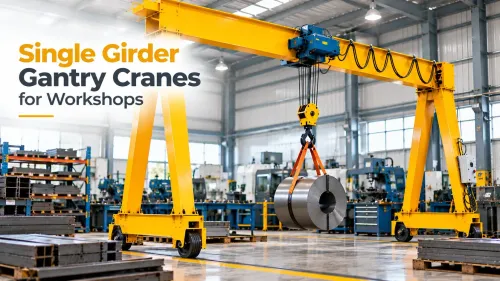
| Gantry | Broad coverage; bridge runs on legs and floor rails | Avoids building reinforcement but occupies floor space and can block aisles, doors, utilities, and emergency routes | Buildings that cannot support runway loads |
| Jib | Local rotation around one column or workstation | Compact installation; limited pickup radius and capacity | One loading, assembly, or machine station |
| Monorail | Fixed route along one beam or track | Efficient installation on a defined path; cannot serve off-route points | Repetitive movement between set locations |
| Forklift | Flexible floor movement; load stays on forks | Needs aisles, turning space, visibility, and load-stability controls | Variable point-to-point handling |
| Mobile crane | Temporary or outdoor lifting from a setup position | Requires access, ground bearing, setup time, and exclusion zones | Infrequent lifts or changing outdoor locations |
For changing production, price runway extensions, transfer points, remote controls, and below-hook tooling before fixing the geometry. An EOT also permits faster repeated handling than a forklift, while a gantry or mobile crane is easier to reposition when the building cannot be modified.
Specify Power, Controls, and Environmental Protection
An electric crane selection guide must specify the factory’s supply voltage, phase, frequency, available fault current, conductor-bar or festoon arrangement, collector type, permitted voltage drop, control voltage, isolation method, and lockable disconnect location. Omitting these details can leave a mechanically suitable crane unsafe or impossible to connect.
Put these motion requirements in the RFQ:
- Separate hoist, bridge, and trolley speeds, with acceleration and deceleration limits.
- Inching or creep speed, positioning accuracy, braking behaviour, and brake-release response.
- Synchronized motion for multiple hoists or cranes, plus anti-sway control where load movement threatens people, equipment, or cycle time.
- Variable-frequency drives where smooth starts, stops, positioning, and reduced mechanical shock matter. A drive does not increase rated capacity.
State whether the crane will face outdoor rain and wind, corrosion, temperature extremes, foundry radiant heat, washdown, or classified explosive dust and vapour zones. Require the matching enclosure rating, heat shielding, corrosion protection, and electrical equipment approved for the classified location; standard crane electrics are not acceptable in a hazardous zone.
Add seismic design loads and wind forces where applicable, including outdoor wind-induced movement. Ask for bridge and trolley weights, motor ratings, environmental ratings, and applicable design standards before comparing quotations.
Compare RFQs by Safety, Serviceability, and Total Fit
The practical answer to how to choose an electric overhead crane for a factory is to compare the complete operating envelope, not identical capacity labels. Require every supplier to use the same load, duty, clearance, structural, electrical, and lifecycle assumptions.
| Criterion | Require in every quotation | Why it changes the decision |
|---|---|---|
| Duty and structure | Duty classification; bridge and trolley weights; maximum wheel loads; runway reactions; foundation assumptions | Determines building cost and structural suitability |
| Geometry | Wheel and rail sizes; end and side hook approaches; drawings | Exposes unreachable pickup points and installation conflicts |
| Performance | Hoist reeving; motor ratings; lifting, bridge, and trolley speeds; control architecture | Reveals handling capability and maintenance complexity |
| Environment | Environmental rating, noise expectation, and applicable design standards | Prevents failures in heat, dust, moisture, or restricted areas |
Also compare inspection access, operator controls, spare-parts availability, manuals, training, commissioning tests, and the proposed maintenance schedule. In the United States, OSHA 29 CFR 1910.179 sets frequent inspections from daily to monthly intervals and periodic inspections based on service severity; identify the rules governing your site.
Derrick Engi Works Private Limited can join the RFQ, but evaluate its submission beside every competing quotation. Select the crane that fits production, structure, and maintenance realities—not the cheapest purchase price or largest headline capacity.
Related products
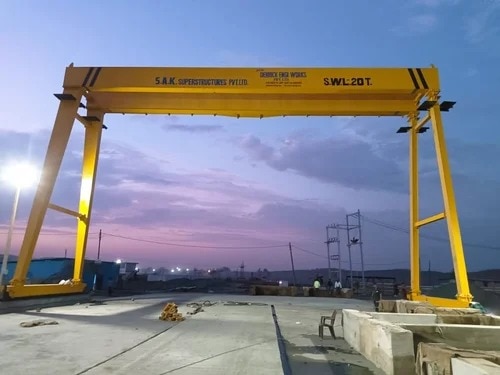 | Eot Cranes Electric Overhead Traveling Crane Manufacturer Derrick Engi Works Pvt. Ltd. is a trusted manufacturer and supplier of Electric Overhead Traveling Cranes, designed for efficient, safe,... |
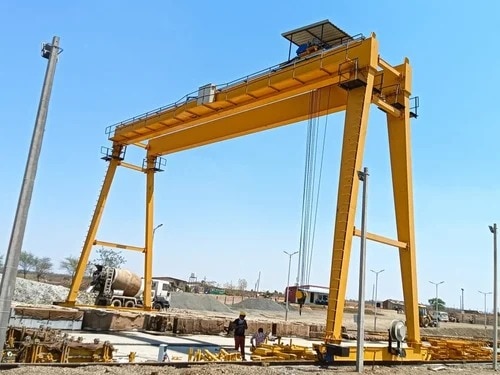 | Eot Cranes Single Girder Overhead Travelling Crane Manufacturer Derrick Engi Works Pvt. Ltd. is a trusted manufacturer and supplier of Single Girder Overhead Travelling Cranes, designed for efficient... |
Frequently asked questions
How do you calculate the load for a factory EOT crane?
Add the product weight to the hook, slings, spreader beam, magnet, grab, lifting frame, and every other below-hook device used during the heaviest lift.
What measurements are needed before requesting an overhead crane quote?
Provide the bay width, runway length, available headroom, lift height, hook travel, column and runway details, and the complete hook envelope required for each lift.
When should you choose a single-girder or double-girder overhead crane?
Choose between them from the required span, gross load, lift height, duty cycle, hook approach, and working envelope rather than load capacity alone.
What should you compare in electric overhead crane RFQs?
Compare rated capacity, duty classification, safety devices, controls, electrical protection, service access, spare parts, installation requirements, and fit with your factory layout.
Related product
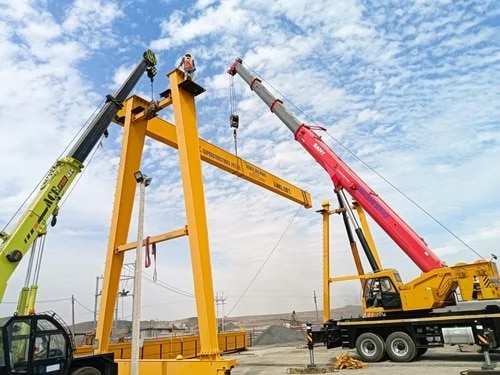 | Eot Cranes Gantry Crane Single Girder Crane Manufacturer Derrick Engi Works Pvt. Ltd. is a reliable manufacturer and supplier of Gantry Crane Single Girder Cranes, designed for efficient... |