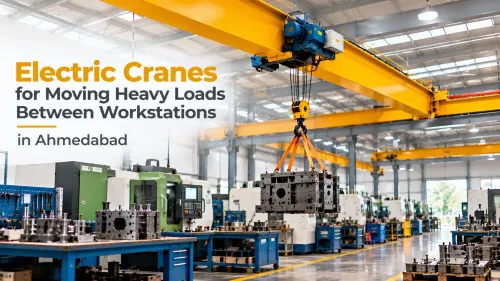

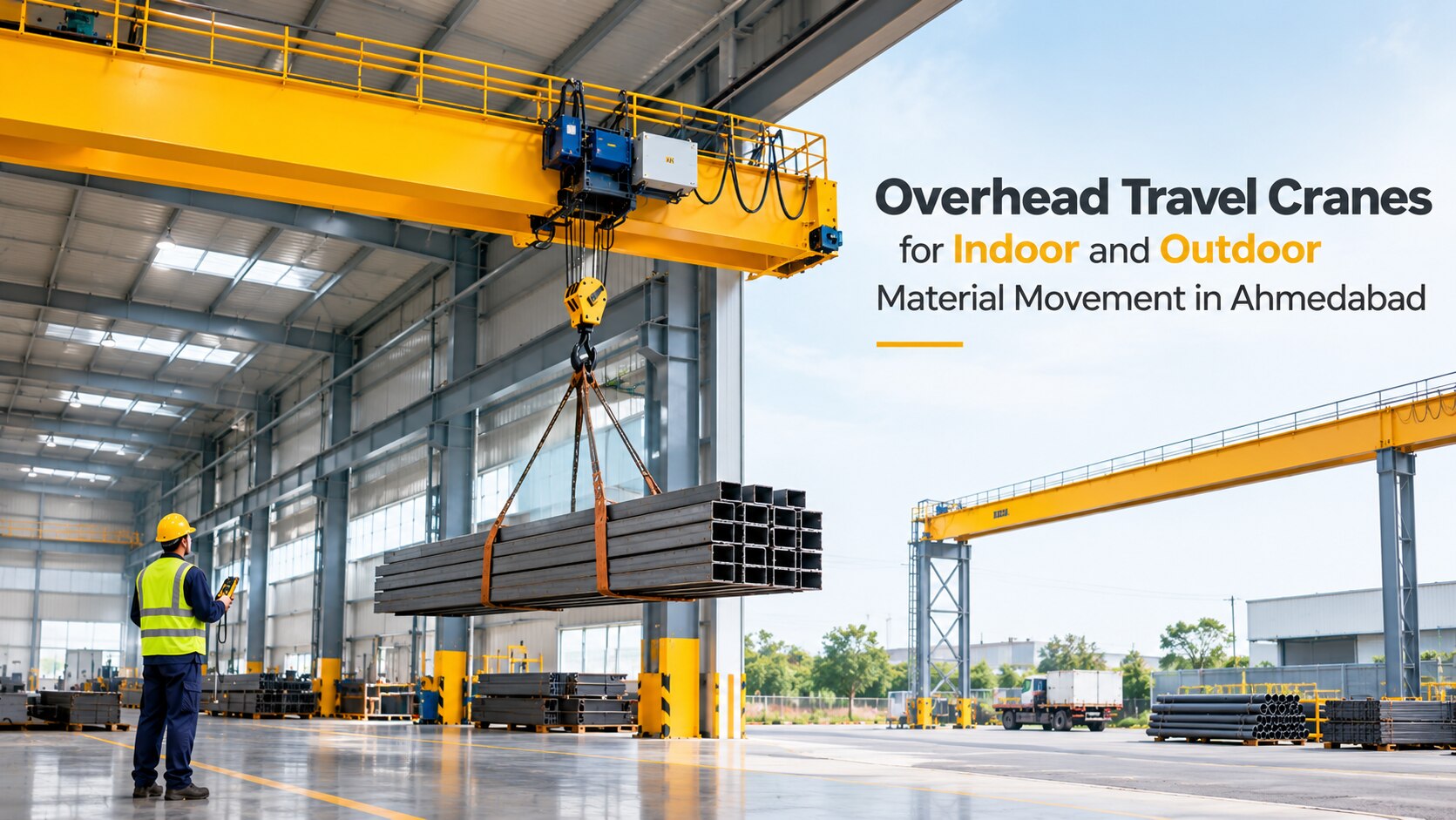
Choosing between a building-supported EOT crane, a freestanding gantry, a forklift, and a jib crane depends on the load path, site structure, duty cycle, and weather exposure. You will be able to identify the right crane arrangement, define its technical specification, and check the Ahmedabad site risks before requesting comparable quotations.
Key takeaways
- Map pickup, travel, and set-down points before selecting crane capacity.
- Choose EOT cranes for enclosed bays and gantry cranes for open yards.
- Compare crane height, span, duty cycle, and power supply with site conditions.
- Request load tests, inspection records, emergency stops, and weather protection details.
How the Crane Moves a Load Through a Factory or Yard
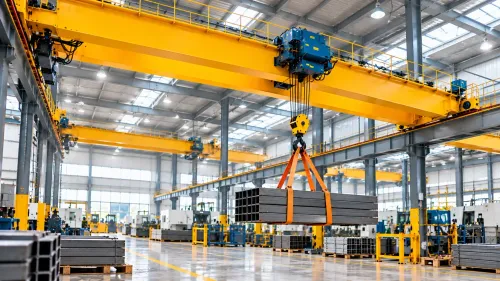
An overhead crane moves a load in three directions, and each direction fixes a different part of the factory or yard layout. The lifting envelope must cover the pickup point, travel route, and final set-down point without striking the building or stored materials.
- Hoist movement raises or lowers the load. It determines floor-to-hook height, required lift, hook approach, and clearance below roof beams, lights, ducts, and sprinklers.
- Trolley cross travel moves the hoist across the bridge span. It determines bay width, side clearances, and whether the hook can reach both edges of a production line, machine, or storage bay.
- Bridge long travel carries the crane along runway rails. It determines runway length, end clearances, loading-bay access, and the positions where loads can be collected or delivered.
For an overhead crane for indoor handling, survey the runway beams, columns, rail alignment, bay width, roof obstructions, electrical supply, and wheel-load reactions before fixing the quotation. The crane’s rated load does not prove that the existing structure can support the runway system.
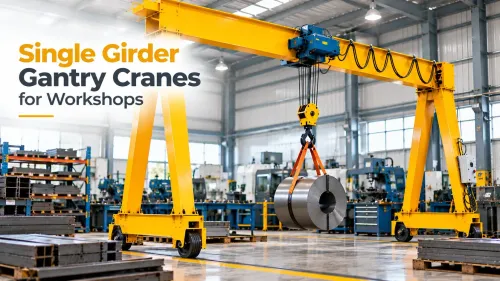
An overhead crane for outdoor handling needs a different plan when no building runway exists. A gantry crane brings its own legs, rails, foundations, end stops, drainage, vehicle interfaces, and storm parking into the layout.
Wind loads apply even when the hook is empty, so specify operating and out-of-service wind limits for the actual Ahmedabad site.
Overhead EOT Cranes Versus Outdoor Gantry Cranes
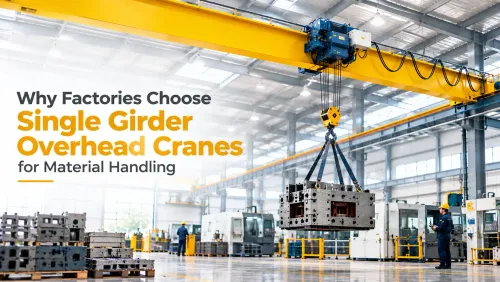
Choose a top-running EOT crane indoors when the building can support runway beams or brackets and you need efficient coverage across a production bay, warehouse, machine shop, or fabrication area. The bridge wheels run on rails above the crane, providing greater headroom and capacity than an under-running arrangement.
Use an under-running EOT crane when roof height, building structure, or existing runway geometry prevents a conventional top-running installation. It hangs from the underside of the runway, making it useful for lighter loads and close hook approaches, but verify the supporting roof or beams rather than assuming the building can carry the wheel loads.
| Option | Structure | Best fit | Main constraint |
|---|---|---|---|
| Top-running EOT | Rails on runway beams or brackets | High-capacity indoor production and storage | Requires adequate columns, beams, and headroom |
| Under-running EOT | Crane runs beneath the runway | Restricted headroom or lighter indoor handling | Lower structural capacity and tighter clearance checks |
| Gantry crane | Legs, wheels, rails, and portal frame | Open yards without a building runway | Needs foundations, stability, drainage, and vehicle control |
A gantry is the better overhead crane for outdoor handling in open storage, precast, or steel stockyards. An overhead crane for outdoor handling still works where a suitable runway already exists, but wind applies even when unloaded.
- Specify Ahmedabad site wind speed, exposure, operating and out-of-service limits, storm locks, and parking position.
- Survey rail foundations, settlement, drainage, end stops, and vehicle interfaces.
- State IS 3177 and IS 807 editions, duty class, calculations, testing, and acceptance criteria.
Choosing Between a Factory Crane, Forklift, and Jib Crane
Choose based on load, route, lifting frequency, and available space—not rated capacity alone. A factory material movement crane suits repetitive lifts along a defined bay, a forklift suits mobile floor-level routes, and a jib crane suits short-radius service at one workstation. The wrong choice creates congestion, structural alterations, or unused capacity.
| Option | Best fit | Check before choosing |
|---|---|---|
| Factory EOT crane | Heavy or awkward loads travelling across a production bay, warehouse, or fabrication area | Confirm runway capacity, headroom, hook approaches, and building columns |
| Forklift | Pallets, containers, and loads moving between floor-level points, doors, trucks, or outdoor areas | Allow for aisle width, turning radius, floor strength, ramps, traffic separation, and operator visibility |
| Jib crane | Frequent lifts beside one machine, bench, loading point, or assembly station | Confirm the 180- or 360-degree sweep, foundation or wall strength, and lifting radius |
For an EOT crane, specify the rated load including slings, magnets, grabs, lifting beams, or tooling. Also define span, lift, duty class, working speeds, control method, starts per hour, load spectrum, ambient temperature, and required hook approaches. A crane sized only for maximum weight can fail its fatigue-duty requirement.
Use a forklift when the route changes daily or the load must enter a truck. Use a jib when the load rarely leaves one work zone. Choose the factory crane when the same bay needs repeated, controlled lifts and floor space must remain clear.
Prohibit side pulling, dragging, people lifting, and loads above the stated wind or temperature limits.
Specification and Ahmedabad Site Checks Before You Buy
A reliable quotation starts with a defined crane type and a measured site, not the safe working load alone.
For overhead travel crane material movement in Ahmedabad, state whether you need a top-running EOT crane on runway beams or brackets, or an under-running EOT crane suspended beneath the runway where headroom or building structure limits the arrangement.
1. Record the operating specification: rated load, span, lift, hook approaches, duty class, working speeds, control method, starts per hour, average load spectrum, ambient temperature, and the weight of the lifting device. A crane selected only by maximum load can fail its fatigue duty or become too slow for production.
2. Complete an indoor building survey before pricing. Measure bay width, floor-to-hook height, roof obstructions, rail alignment, electrical supply, and hook travel. Obtain runway-beam capacity, column reactions, wheel-load limits, and connection details; the crane’s rating does not prove that the existing structure can carry it.
3. For outdoor handling, provide the actual Ahmedabad site’s basic wind speed, exposure, projected areas, operating wind limit, and out-of-service wind condition. Specify rail clamps or storm locks and the parking position for the hoist and trolley. Never copy wind values from a catalogue.
4. Confirm clearances and commercial scope. Check the 3-inch overhead and 2-inch lateral clearances used for new construction under OSHA’s overhead-crane rule, then verify Indian statutory and engineering requirements.
Ask a crane supplier Ahmedabad buyers can compare to separate runway beams, rails, conductor bars, controls, isolator, festoon, stops, buffers, commissioning, load testing, training, documentation, and alignment.
Derrick Engi Works Private Limited can be included in the comparison when its quotation identifies these site-specific inclusions rather than presenting only a crane price.
Related products
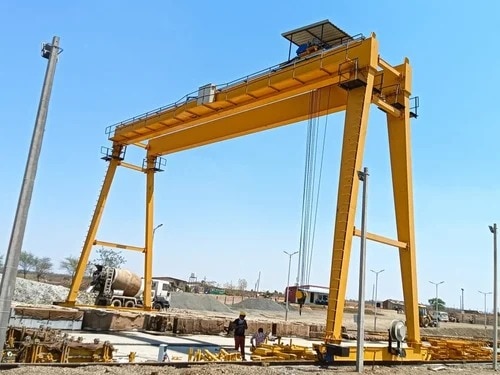 | Eot Cranes Single Girder Overhead Travelling Crane Manufacturer Derrick Engi Works Pvt. Ltd. is a trusted manufacturer and supplier of Single Girder Overhead Travelling Cranes, designed for efficient... |
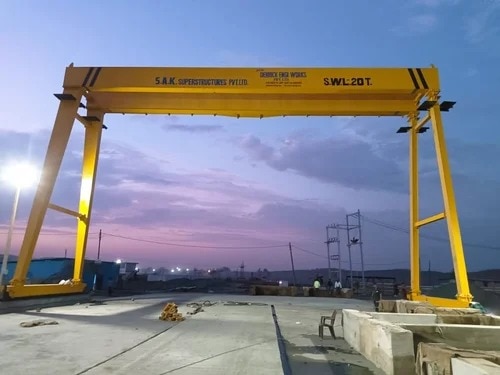 | Eot Cranes Electric Overhead Traveling Crane Manufacturer Derrick Engi Works Pvt. Ltd. is a trusted manufacturer and supplier of Electric Overhead Traveling Cranes, designed for efficient, safe,... |
Outdoor Weather Protection, Controls, Testing, and Inspection
A crane control specification must stop unsafe motion before a small fault becomes a dropped load. Require controlled hoist, cross-travel, and long-travel acceleration, inching or creep control, an emergency stop, overload protection, and upper and lower hoist limits.
Add travel limits for the trolley and bridge, anti-collision protection where cranes share a bay, and phase-loss and incorrect-phase-sequence protection.
- Use a variable-frequency drive when accurate positioning and reduced mechanical shock justify the added cost.
- Provide cooling for each drive enclosure and a plan for heat, dust, and harmonic effects.
- Match braking equipment to the load, duty class, stopping distance, and emergency-stop behaviour.
- Protect outdoor motors, panels, festoons, and conductor bars against dust, monsoon rain, sunlight, condensation, and water ingress.
- Specify drain holes, sealed bearings where appropriate, corrosion-resistant fasteners, and a documented coating system.
- Design gantry legs, wheels, rails, foundations, end stops, rail clamps, drainage, vehicle interfaces, and storm-parking arrangements as one system.
Commissioning must include alignment checks, unloaded function tests, limit-switch tests, brake tests, overload verification, emergency-stop tests, and a documented load test. Record the crane duty classification using CMAA service class or FEM/ISO utilization group; “heavy duty” is not a rating.
After handover, schedule frequent inspections from daily to monthly according to use, plus periodic inspections at intervals from one to twelve months. Examine hooks, wire rope, brakes, limits, structure, rails, and electrical equipment, then record defects, responsible persons, and closure dates.
Frequently asked questions
How does an overhead crane move a load through a factory or yard?
The hoist lifts and lowers the load, the trolley moves it across the bridge, and the end trucks move the bridge along runway rails. Plan all three movements around columns, stored materials, doors, and the final set-down area.
When is an EOT crane better than an outdoor gantry crane?
Use an EOT crane when the building can support runway rails and you need clear floor space inside a factory. Use a gantry crane when the work is outdoors or the site cannot provide elevated building-supported runways.
How do you choose between a factory crane, forklift, and jib crane?
Choose a factory crane for repeated lifting across a defined bay, a forklift for mobile loads and short routes, and a jib crane for local lifting around one workstation. Compare load weight, travel distance, lifting height, floor access, and required cycle time.
Which Ahmedabad site checks are needed before buying a crane?
Check the maximum load, span, lifting height, runway or gantry foundation, building clearances, floor condition, power supply, wind exposure, operating temperature, and the route between pickup and delivery points.
What outdoor protection, testing, and inspection details should you request?
Ask about enclosure and corrosion protection for motors and controls, rain covers, limit switches, emergency stops, overload protection, commissioning tests, rated-load testing, inspection records, and a maintenance schedule.
Related product
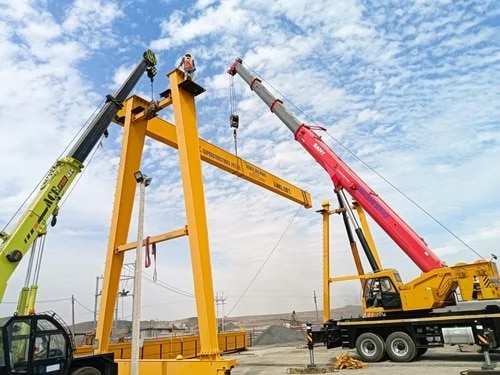 | Eot Cranes Gantry Crane Single Girder Crane Manufacturer Derrick Engi Works Pvt. Ltd. is a reliable manufacturer and supplier of Gantry Crane Single Girder Cranes, designed for efficient... |